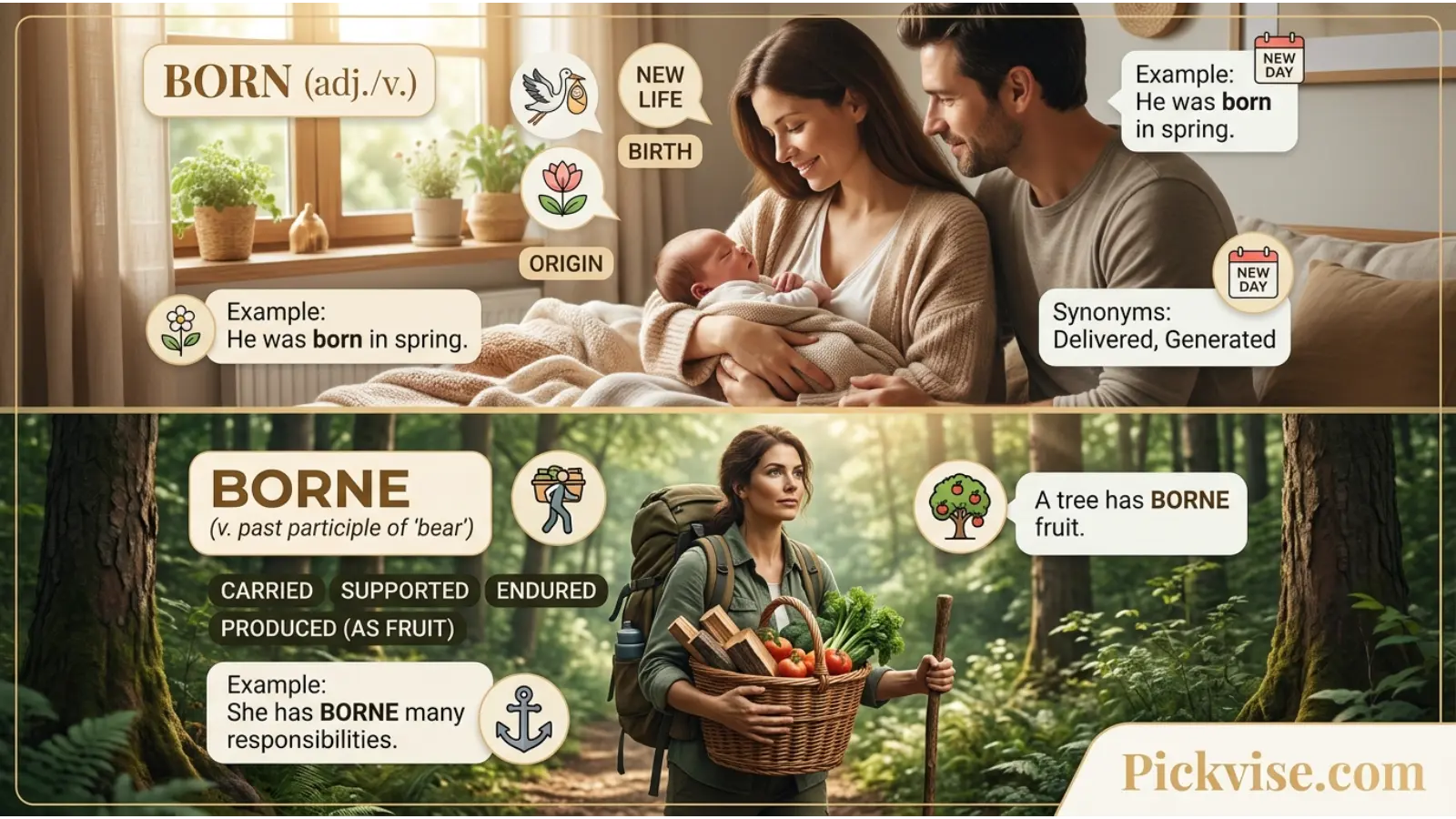
Born or Borne may look similar, but they have different meanings. Many English learners confuse these two words because both come from the verb bear. However, they are not interchangeable. Using the wrong word can change the meaning of your sentence.
In simple terms, born relates to birth. Borne means carried, supported, accepted, or spread. Knowing the difference helps you write and speak English more accurately.
This guide explains the meaning of born or borne with simple definitions, clear examples, and easy tips. By the end, you will know when to use each word with confidence.
Quick Summary
- Born refers to birth or coming into life.
- Borne means carried, transported, supported, or accepted.
- Both words come from the verb bear.
- Use born only when talking about birth.
- Use borne for carrying, enduring, or spreading something.
- Remember: Birth = Born, Carry = Borne.
Born or Borne Comparison Table
| Feature | Born | Borne |
|---|---|---|
| Main meaning | Given birth or brought into life | Carried, supported, endured, or transported |
| Verb origin | Bear | Bear |
| Used for | Birth and origin | Carrying, accepting, or spreading |
| Common examples | Born in Canada | Borne by the wind |
| Part of speech | Past participle (birth only) | Past participle (all other meanings) |
What Does “Born” Mean?
Born is the past participle of bear when it means to give birth or to come into life.
People use born to talk about someone’s birth, origin, or natural ability.
Simple Definition
Born means brought into life through birth.
Examples
- She was born in 2010.
- I was born in Pakistan.
- The twins were born yesterday.
- He was born into a large family.
- Some people are born with musical talent.
In every example, born relates to birth.
What Does “Borne” Mean?
Borne is the past participle of bear for every meaning except birth.
It means carried, transported, accepted, supported, or endured.
Simple Definition
Borne means carried or accepted something.
Examples
- The bridge has borne heavy traffic for years.
- The costs were borne by the company.
- The seeds were borne by the wind.
- She has borne many challenges.
- The message was borne across the country.
Each sentence shows carrying, supporting, or enduring—not birth.
The Main Difference Between Born and Borne
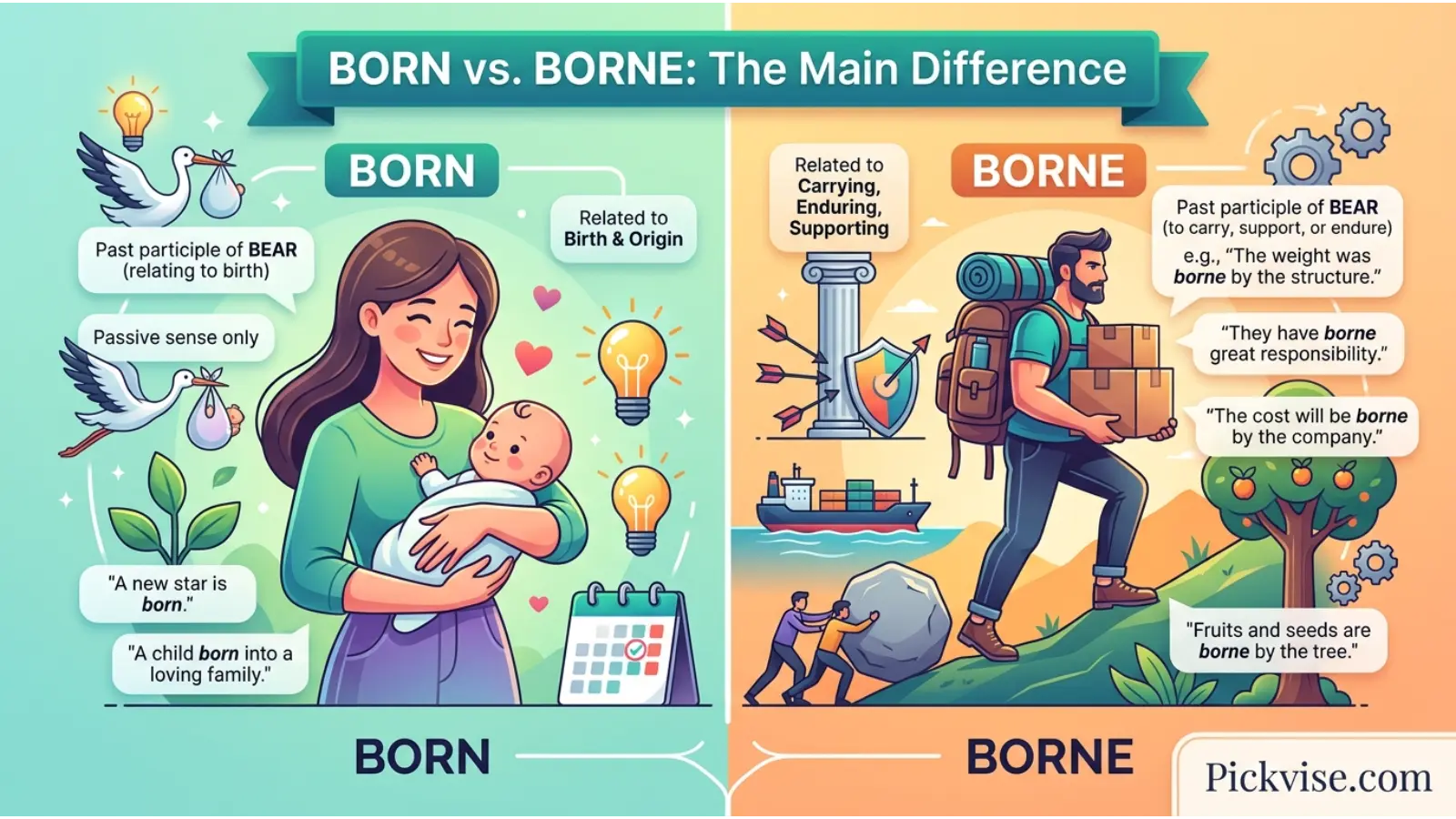
The easiest way to remember the difference is to think about the topic.
If you are talking about birth, use born.
If you are talking about carrying, enduring, supporting, or transporting, use borne.
Quick Rule
- Birth → Born
- Carry or Endure → Borne
This simple rule works in almost every situation.
When Should You Use “Born”?
Use born whenever your sentence relates to birth or someone’s beginning in life.
Common Situations
Talking About Birth
- She was born in London.
- My son was born in April.
Talking About Nationality or Origin
- He was born in Canada.
- They were born overseas.
About Natural Talent
- She was born to lead.
- He was born to sing.
Talking About Family
- The baby was born healthy.
- Their daughter was born last week.
Notice that every example connects to life or birth.
When Should You Use “Borne”?
Use borne when someone or something carries, supports, accepts, or experiences something.
Carrying Something
- The flag was borne by the soldiers.
- Leaves were borne along the river.
Accepting Responsibility
- The expense was borne by the owner.
- She has borne the burden alone.
Enduring Difficulty
- He has borne great pain.
- They bore the pressure well.
Transporting Something
- Dust was borne through the air.
- The sound was borne across the lake.
These examples never describe birth.
Real-Life Examples of Born and Borne
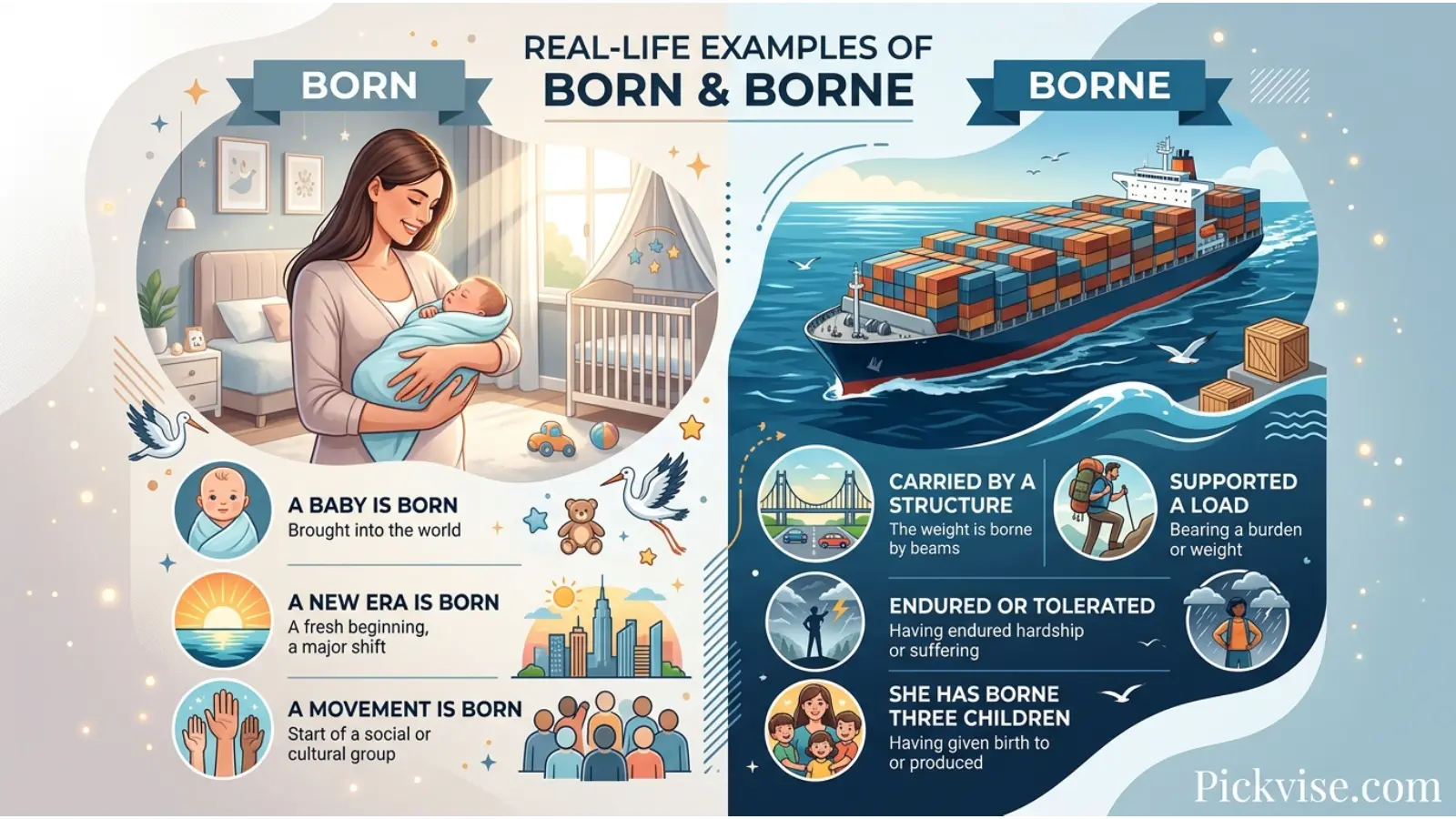
Learning through everyday situations makes these words easier to remember.
Example 1: Family
✅ Emma was born in 2015.
The sentence talks about birth.
Example 2: Business
✅ The company borne all repair costs.
The company accepted the expenses.
Example 3: Nature
✅ The seeds were borne by the wind.
The wind carried the seeds.
Example 4: Sports
✅ He was born with amazing athletic ability.
This describes a natural talent from birth.
Example 5: Travel
✅ The supplies were borne by trucks.
The trucks carried the supplies.
Born vs. Borne in Common Expressions
Some phrases appear often in books, news, and daily conversations.
Common Expressions with “Born”
- Born and raised
- Born yesterday
- Born into wealth
- Born to win
- Born leader
- Born athlete
Common Expressions with “Borne”
- Borne by the wind
- Borne out by evidence
- Costs borne by taxpayers
- Burden borne by workers
- Disease borne by insects
- Water-borne illness
- Air-borne particles (more commonly written as airborne)
Learning these phrases helps you recognize the correct word quickly.
Why Do People Confuse Born and Borne?
Many learners make mistakes because both words come from the same verb, bear.
The confusion grows because English uses different past participles for different meanings of the same verb.
Here is the simple rule again:
- Use born only for birth.
- Use borne for every other meaning of bear.
Once you remember this rule, choosing the correct word becomes much easier.
Featured Snippet: Born or Borne
Born refers to birth or coming into life, while borne means carried, supported, accepted, endured, or transported. Although both words come from the verb bear, born is used only for birth-related meanings, and borne is used for all other meanings.
Common Mistakes When Using Born and Borne
Many writers mix up born and borne because both come from the verb bear. However, they have different uses.
Here are some common mistakes and the correct forms.
| Incorrect | Correct | Why? |
|---|---|---|
| She was borne in 2005. | She was born in 2005. | Birth requires born. |
| I was borne in London. | I was born in London. | It refers to birth. |
| The cost was born by us. | The cost was borne by us. | The cost was carried or accepted. |
| The supplies were born by truck. | The supplies were borne by truck. | Trucks carried the supplies. |
| The burden was born by everyone. | The burden was borne by everyone. | It means endured or shared. |
Quick Tip:
If the sentence talks about birth, use born. Otherwise, use borne.
Easy Tips to Remember the Difference
These tricks make the difference easy to remember.
1. Think About Birth
If someone came into the world, choose born.
Example:
- She was born in Italy.
2. Think About Carrying
If something carries, supports, or transports, choose borne.
Example:
- The package was borne by a delivery truck.
3. Remember This Formula
- Birth = Born
- Carry = Borne
This simple rule works almost every time.
4. Check the Meaning
Ask yourself:
“Is this sentence about someone’s birth?”
- Yes → Born
- No → Borne
How to Use Born and Borne in Daily Life
These words appear in many everyday situations.
At School
- She was born in Australia.
- The project costs were borne by the school.
At Work
- The company borne all expenses. ❌
- The company borne all expenses. (Better: “The company has borne all expenses.”) ✅
In News Reports
- The disease is mosquito-borne.
- The child was born yesterday.
Conversations
- I was born in Lahore.
- The responsibility was borne by my team.
In Books
Authors often use borne when describing journeys, burdens, or emotions.
They use born when introducing characters or discussing their background.
Synonyms and Related Words
Using related words improves your vocabulary and helps with SEO.
Synonyms for Born
- Delivered
- Brought into the world
- Native
- Originated
- Produced
Synonyms for Borne
- Carried
- Transported
- Supported
- Endured
- Accepted
- Sustained
- Conveyed
Expert Insight
Grammar mistakes may seem small, but they affect clarity and credibility.
Professional writers choose born only for birth-related meanings. They use borne whenever something is carried, supported, accepted, or endured.
Many grammar errors happen because both words come from bear. Learning their different meanings improves your writing and makes your message easier to understand.
A simple grammar habit can make a big difference.
Remember this rule:
Birth uses “born.” Everything else uses “borne.”
Following this guideline will help you write more naturally and confidently.
Frequently Asked Questions (FAQs)
Is it “born” or “borne” in England?
Use born when talking about birth.
Example:
He was born in England.
Can “borne” mean born?
No.
Borne never refers to birth. It means carried, supported, accepted, or transported.
Why do both words come from “bear”?
The verb bear has several meanings.
English uses born only for birth. It uses borne for all other meanings.
Is it “borne by the wind” or “born by the wind”?
The correct phrase is borne by the wind because the wind carries something.
Is “waterborne” spelled as one word?
Yes.
Words like waterborne, airborne, and foodborne are usually written as one word.
Is “born to win” correct?
Yes.
It refers to a natural ability or destiny from birth.
Is “cost borne by” correct?
Yes.
It means someone accepted or paid the cost.
Can I use “born” for carrying something?
No.
Use borne whenever something is carried or supported.
Conclusion
Understanding the difference between born or borne is easier than it first appears. Although both words come from the verb bear, they have different meanings and uses. Use born only when talking about birth, origin, or natural ability. Use borne when something is carried, supported, accepted, endured, or transported. A simple memory trick can help: Birth equals born. Carry equals borne. This rule covers nearly every situation. With regular practice and real-life examples, choosing the correct word becomes natural. The next time you write born or borne, you’ll know exactly which one fits your sentence.