Dissatisfied or Unsatisfied often confuse English learners because both words describe a lack of happiness or fulfillment. However, they do not always mean the same thing. Knowing the difference helps you speak and write more clearly. Many people use these words as if they are equal. Yet, each word fits different situations. Unsatisfied usually means something is not complete or fulfilled. Dissatisfied often shows disappointment or unhappiness with a result, service, or experience. This guide explains both words in simple English. You will learn their meanings, differences, examples, common mistakes, and easy tips. By the end, you will know exactly when to use dissatisfied and when unsatisfied is the better choice.
Quick Summary
- Dissatisfied means unhappy or disappointed.
- Unsatisfied means not fulfilled, completed, or met.
- Dissatisfied often refers to opinions or feelings.
- Unsatisfied often refers to needs, desires, or conditions.
- Both words can sometimes overlap, but they are not always interchangeable.
What Does “Dissatisfied” Mean?
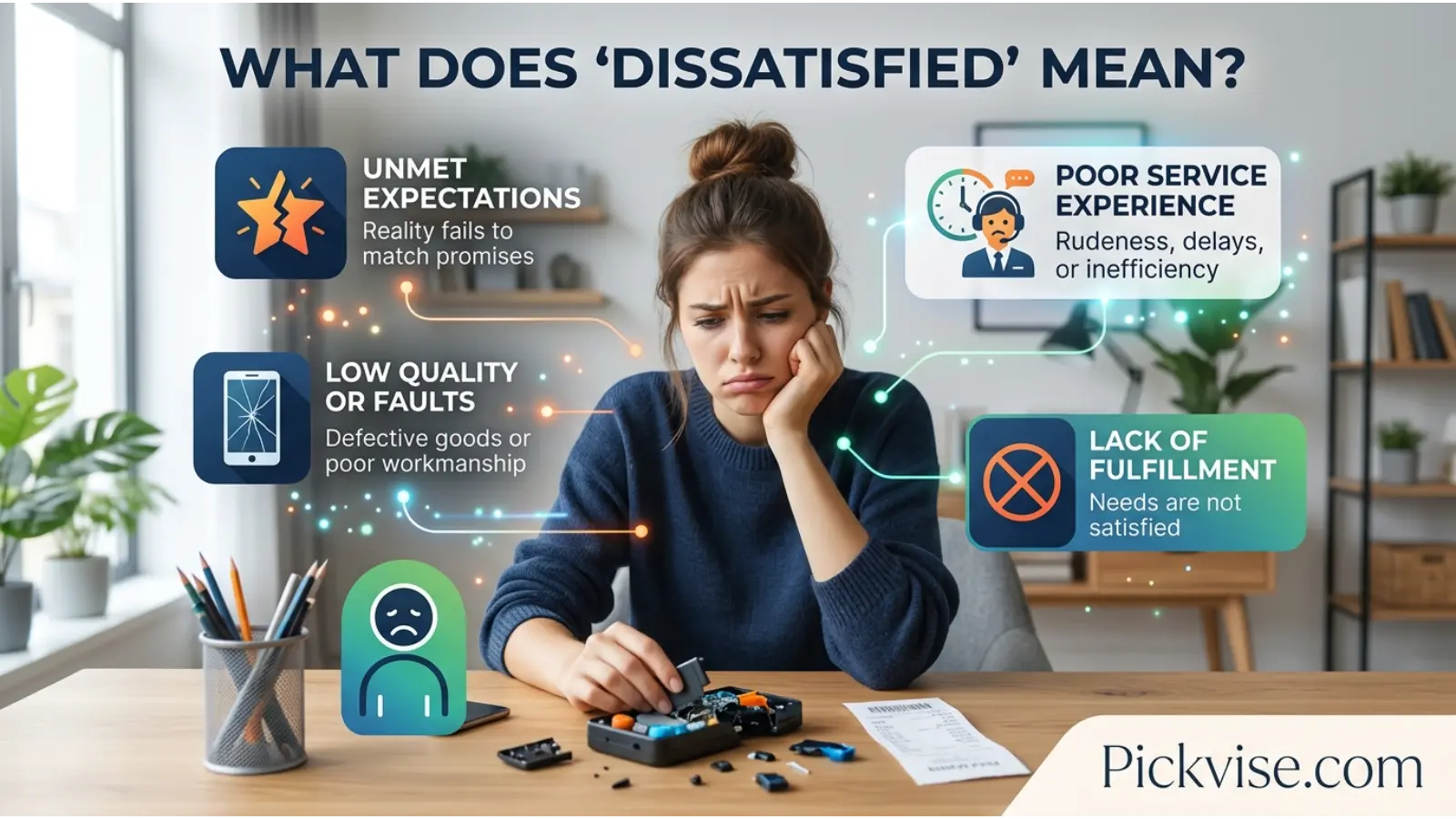
Dissatisfied means not pleased or unhappy with something.
People become dissatisfied when something fails to meet their expectations.
Examples
- She felt dissatisfied with the hotel’s service.
- Customers were dissatisfied with the long wait.
- He left the meeting feeling dissatisfied.
Simple Definition
Dissatisfied = unhappy because something was not good enough.
What Does “Unsatisfied” Mean?
Unsatisfied means not fulfilled, not completed, or not met.
It often describes needs, desires, requirements, curiosity, or conditions.
Examples
- His hunger remained unsatisfied.
- The court found the legal requirement unsatisfied.
- She left with unsatisfied curiosity.
Simple Definition
Unsatisfied = something is still lacking or incomplete.
Dissatisfied or Unsatisfied: Comparison Table
| Feature | Dissatisfied | Unsatisfied |
|---|---|---|
| Meaning | Unhappy or disappointed | Not fulfilled or completed |
| Focus | Feelings and opinions | Needs, desires, conditions |
| Emotion | Stronger emotional feeling | May not involve emotion |
| Common Use | Customers, workers, students | Hunger, curiosity, needs |
| Example | I am dissatisfied with the service. | My curiosity is still unsatisfied. |
The Main Difference Between Dissatisfied and Unsatisfied
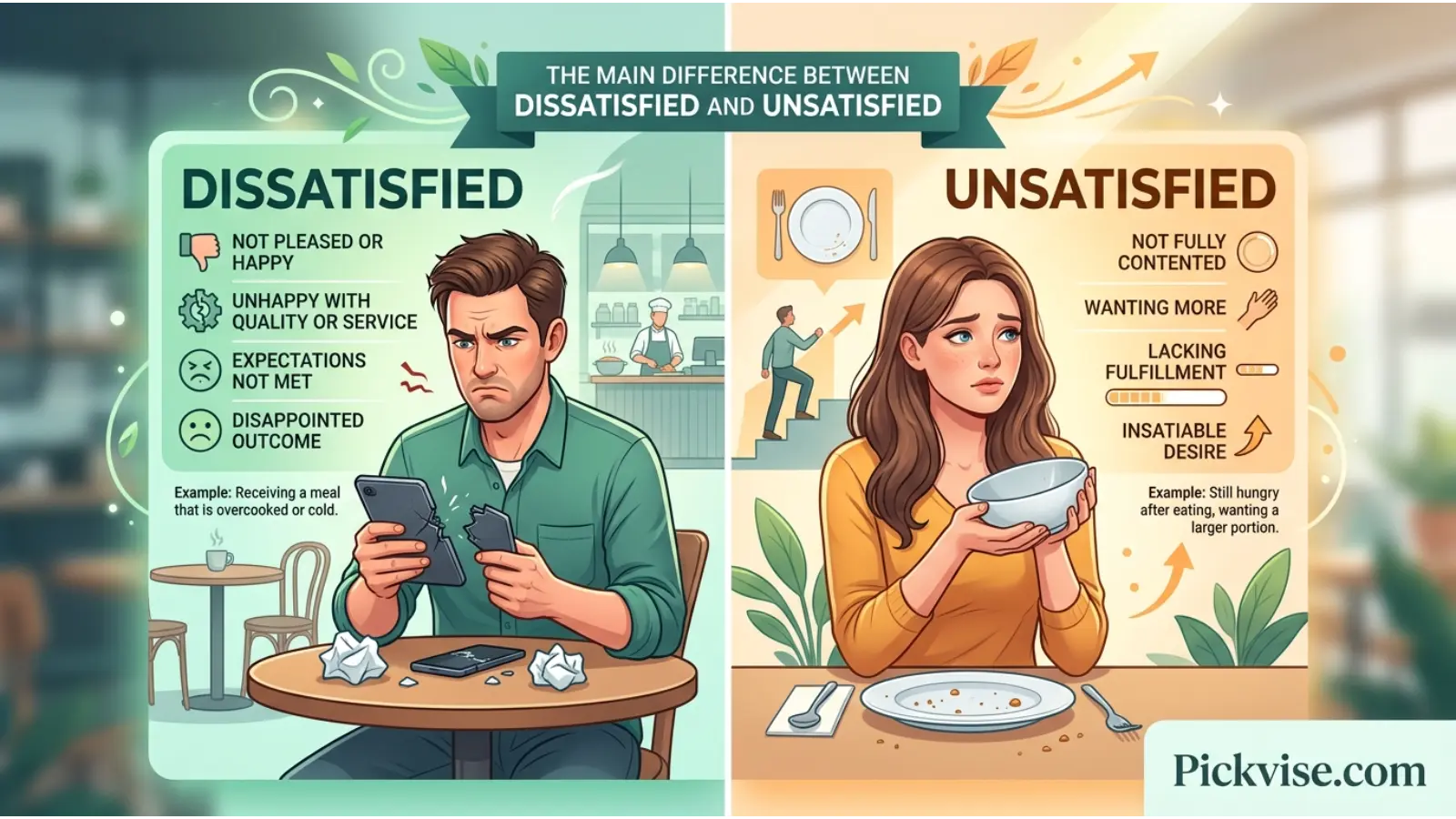
The biggest difference is the reason behind the feeling.
Dissatisfied focuses on disappointment.
Unsatisfied focuses on something that remains incomplete.
Think of it this way:
- Dissatisfied = “I don’t like it.”
- Unsatisfied = “I still need more.”
Real-Life Examples
At a Restaurant
❌ I was dissatisfied with the slow service.
✔ Correct because the customer feels unhappy.
After Dinner
❌ I am still unsatisfied because I need more food.
✔ Correct because hunger is not fulfilled.
At Work
The employees felt dissatisfied with their salaries.
During Study
His curiosity remained unsatisfied after reading the article.
Online Shopping
Many buyers were dissatisfied with the product quality.
When Should You Use “Dissatisfied”?
Use dissatisfied when talking about opinions or disappointment.
Common situations include:
- Customer service
- Product quality
- Jobs
- School
- Hotels
- Restaurants
- Relationships
- Business services
Examples
- I am dissatisfied with my phone.
- She is dissatisfied with her exam result.
- Many workers are dissatisfied.
When Should You Use “Unsatisfied”?
Use unsatisfied when something is still missing.
Common situations include:
- Hunger
- Curiosity
- Needs
- Requirements
- Conditions
- Goals
- Expectations
- Legal rules
Examples
- His thirst remained unsatisfied.
- The contract requirements were unsatisfied.
- Her curiosity stayed unsatisfied.
Common Mistakes
Mistake 1
❌ I am unsatisfied with the customer service.
✔ Better:
I am dissatisfied with the customer service.
Mistake 2
❌ My hunger is dissatisfied.
✔ Correct:
My hunger is unsatisfied.
Mistake 3
❌ The requirement is dissatisfied.
✔ Correct:
The requirement is unsatisfied.
Mistake 4
❌ Customers were unsatisfied with the hotel.
✔ Better:
Customers were dissatisfied with the hotel.
Easy Trick to Remember
Remember this simple rule:
D = Disappointed
U = Unfulfilled
If someone feels unhappy, choose dissatisfied.
If something remains incomplete, choose unsatisfied.
Synonyms of Dissatisfied
- Unhappy
- Disappointed
- Displeased
- Frustrated
- Discontent
- Unimpressed
- Upset
- Let down
Synonyms of Unsatisfied
- Unfulfilled
- Incomplete
- Unmet
- Lacking
- Wanting
- Unresolved
- Pending
- Deficient
Daily Life Usage
You hear these words in many situations.
School
Students felt dissatisfied with the grading system.
Shopping
Customers were dissatisfied with the delivery time.
Health
His nutritional needs remained unsatisfied.
Business
The client’s expectations were dissatisfied.
Reading
My curiosity stayed unsatisfied after the book ended.
Expert Insight
Choosing the correct word improves your writing and makes your meaning clearer.
Professional writers use dissatisfied when discussing emotions or opinions. They choose unsatisfied when describing needs, goals, or conditions that remain unmet.
Understanding this difference also helps in business writing, academic essays, customer service, and everyday conversations. Small word choices can make your English sound more natural and accurate.
Frequently Asked Questions
Is dissatisfied the same as unsatisfied?
No. Dissatisfied means unhappy, while unsatisfied means not fulfilled or completed.
Which word is stronger?
Dissatisfied usually expresses stronger emotion.
Can I say “unsatisfied customer”?
Yes, but dissatisfied customer sounds much more natural.
Can hunger be dissatisfied?
No.
Hunger is unsatisfied, not dissatisfied.
Can a person be unsatisfied?
Yes.
A person can feel unsatisfied if their needs or goals are not fulfilled.
Can expectations be dissatisfied?
Usually no.
People become dissatisfied when expectations are not met.
Which word is common in customer service?
Dissatisfied is much more common.
How can I remember the difference?
Think:
- Dissatisfied = disappointed
- Unsatisfied = unmet
Featured Snippet Answer
Dissatisfied means unhappy or disappointed because something did not meet expectations. Unsatisfied means something remains unfulfilled, incomplete, or unmet. Use dissatisfied for feelings and opinions, and unsatisfied for needs, desires, or conditions.
Conclusion
Many learners mix up dissatisfied and unsatisfied, but the difference is easy to understand once you know their purpose. Dissatisfied describes disappointment with a person, product, or experience. Unsatisfied describes needs, desires, or conditions that remain unfulfilled. Although the words sometimes overlap, choosing the correct one makes your writing more natural and precise. Whenever you are talking about emotions or opinions, dissatisfied is usually the right choice. When discussing something that is still lacking or incomplete, use unsatisfied. Keeping this simple distinction in mind will help you communicate more confidently in both spoken and written English.