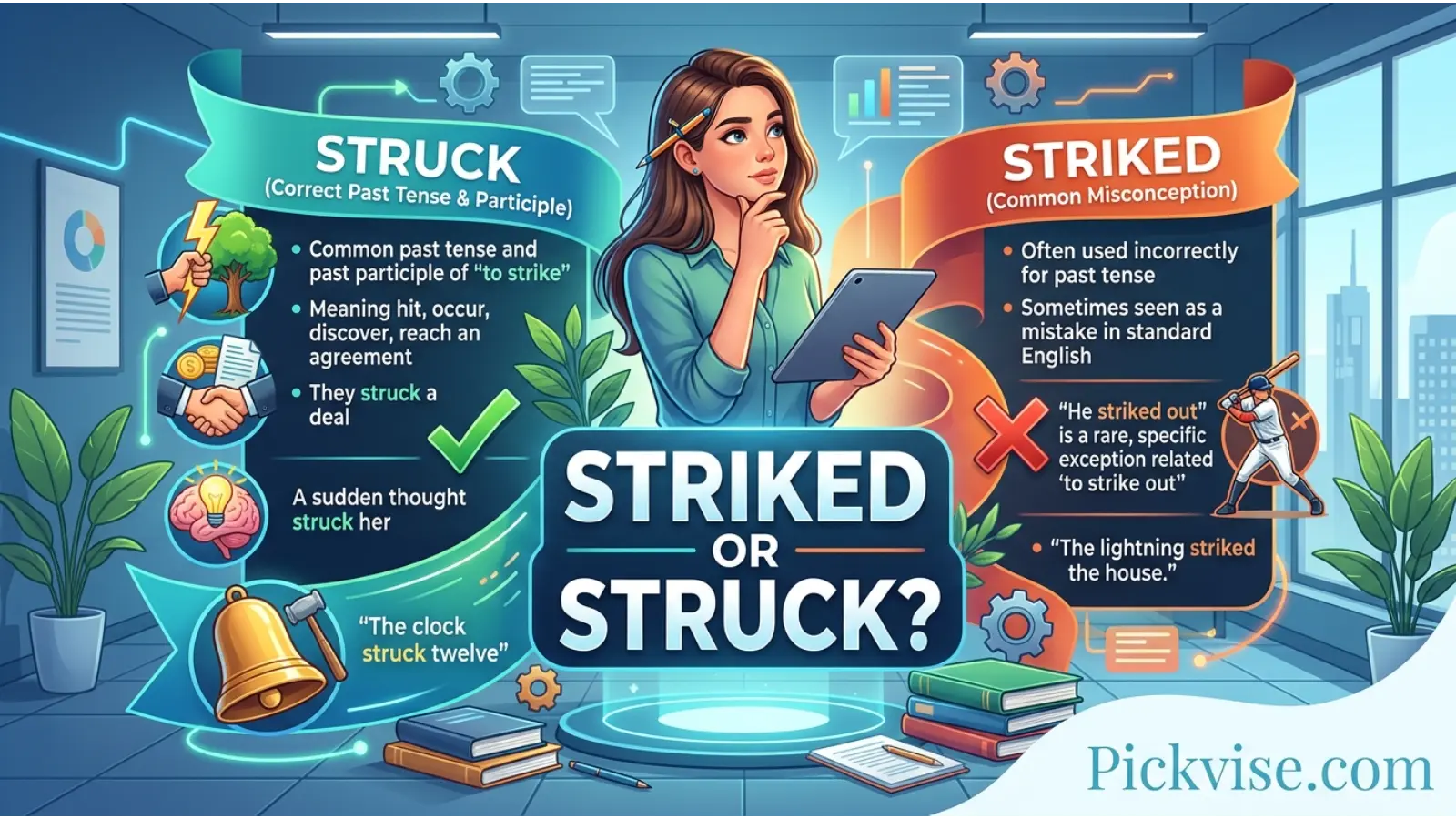
Striked or Struck is a common grammar question. Many English learners and writers get confused about these two words. The good news is that the answer is simple. Only one form is correct in standard English.
The verb strike has irregular forms. Its past tense is struck, not striked. Knowing the correct form helps you write clearly and avoid common mistakes. It also improves your grammar in school, work, and daily conversations.
In this guide, you will learn the difference between striked or struck, see real-life examples, compare both words, and discover easy tips to remember the correct usage.
Quick Summary
- Struck is the correct past tense and past participle of strike.
- Striked is not accepted in standard English.
- Use struck in speaking and writing.
- Remember: strike → struck → struck.
- Using struck makes your English sound natural and correct.
What Does “Strike” Mean?
The verb strike has several meanings depending on the situation.
It can mean:
- To hit something.
- To suddenly have an idea.
- To stop working as a protest.
- To discover something.
- To remove something.
Examples:
- He struck the ball hard.
- An idea suddenly struck me.
- The workers struck for better pay.
- Lightning struck the tree.
Is It Striked or Struck?
The correct word is struck.
Striked is considered incorrect in standard English.
Correct
- She struck the match.
- The clock struck twelve.
- The judge struck the statement from the record.
Incorrect
- She striked the match.
- The clock striked twelve.
Always choose struck when talking about the past.
Why Is “Struck” Correct?
English has many irregular verbs.
These verbs do not simply add -ed to form the past tense.
Examples include:
| Base Verb | Past Tense | Past Participle |
|---|---|---|
| Go | Went | Gone |
| Write | Wrote | Written |
| Speak | Spoke | Spoken |
| Strike | Struck | Struck |
Since strike is irregular, struck replaces the expected striked form.
Striked vs. Struck Comparison Table
| Feature | Striked | Struck |
|---|---|---|
| Standard English | ❌ No | ✅ Yes |
| Past Tense | ❌ Incorrect | ✅ Correct |
| Past Participle | ❌ Incorrect | ✅ Correct |
| Used in Formal Writing | ❌ No | ✅ Yes |
| Used by Native Speakers | Rare | Very Common |
Examples of “Struck” in Real Life

Here are everyday examples.
Sports
- The batter struck the ball over the fence.
Weather
- Lightning struck the building.
Ideas
- A great idea suddenly struck her.
Music
- The pianist struck the first note.
Work
- The workers struck for higher wages.
When Do People Use “Striked”?
People usually write striked because they think every verb follows the regular -ed rule.
This mistake often happens because words like:
- walked
- jumped
- cleaned
follow the normal pattern.
However, strike is an exception.
Native English speakers almost always use struck.
Common Mistakes
Avoid these errors.
Mistake 1
❌ He striked the ball.
✅ He struck the ball.
Mistake 2
❌ Lightning striked the tree.
✅ Lightning struck the tree.
Mistake 3
❌ She has striked the answer.
✅ She has struck the answer.
Learning irregular verbs helps prevent these mistakes.
Easy Trick to Remember
Think of these common verbs.
- Drive → Drove
- Sing → Sang
- Drink → Drank
- Strike → Struck
Do not add -ed.
Instead, remember the phrase:
Strike → Struck → Struck
Practice saying it aloud until it becomes natural.
Using “Struck” in Daily Life

You may see struck in many situations.
At school:
- The teacher struck the wrong answer from the list.
In sports:
- The player struck the winning goal.
news reports:
- An earthquake struck the city.
In conversations:
- Your question struck me as interesting.
Knowing this word improves everyday communication.
Synonyms of Strike
The best synonym depends on the sentence.
Common synonyms include:
- Hit
- Beat
- Knock
- Impact
- Attack
- Affect
- Touch
- Reach
- Inspire
- Discover
Always choose the synonym that matches the context.
Expert Insight
Grammar experts agree that struck is the accepted past tense and past participle of strike. Using the correct verb form improves your writing. It also builds trust with readers, teachers, and employers. Many grammar mistakes happen because English contains irregular verbs. Instead of guessing, learn the common irregular forms through reading and practice. Small grammar improvements make a big difference over time.
Frequently Asked Questions
Is “striked” a real word?
No. It is not accepted in standard English.
What is the past tense of strike?
The past tense of strike is struck.
Is struck the past participle too?
Yes. Struck works as both the past tense and the past participle.
Why do people say “striked”?
People often apply the regular -ed rule to every verb. However, strike is irregular.
Can I use “striked” in formal writing?
No. Always use struck.
What is the verb form of strike?
- Base: Strike
- Past: Struck
- Past Participle: Struck
- Present Participle: Striking
Is “strike” an irregular verb?
Yes. It does not follow the regular -ed pattern.
How can I remember the correct form?
Remember this simple pattern:
Strike → Struck → Struck
Practice it several times until it becomes easy.
These related topics help readers improve their English grammar.
Conclusion
The answer to Striked or Struck is clear. Struck is the correct past tense and past participle of strike, while striked is not accepted in standard English. Learning irregular verbs may seem difficult at first, but regular practice makes them easier to remember. Whenever you talk about hitting something, describing an event, or explaining an idea that came suddenly, use struck with confidence. Keeping this simple grammar rule in mind will improve your writing, speaking, and overall English skills. Remember the easy pattern: strike → struck → struck. Using the correct form helps your communication sound natural, professional, and accurate.