Toward or Towards is a common grammar question for English learners and native speakers alike. Many people wonder which spelling is correct and when to use each one. The good news is that both words are correct. However, their usage depends on the type of English you use.
This guide explains the difference between toward and towards in simple words. You will learn their meanings, spelling differences, real-life examples, and common mistakes. You will also discover which version is more common in American and British English. By the end, you will know exactly when to use each word with confidence.
Quick Summary Box
- Toward and towards have the same meaning.
- Both mean in the direction of, closer to, or regarding.
- Toward is preferred in American English.
- Towards is preferred in British English.
- Neither spelling is grammatically wrong.
- Choose one style and stay consistent in your writing.
What Does Toward or Towards Mean?
Both toward and towards are prepositions. They show movement, direction, or attitude.
They can mean:
- In the direction of something
- Getting closer to a place or goal
- About or concerning someone or something
- Showing a feeling or attitude
Examples
- She walked toward the park.
- He ran towards the bus stop.
- We are working toward success.
- They showed kindness towards their neighbors.
Is There Any Difference Between Toward and Towards?
The meaning is exactly the same.
The only real difference is regional spelling.
| Feature | Toward | Towards |
|---|---|---|
| Meaning | Same | Same |
| American English | Preferred | Less common |
| British English | Less common | Preferred |
| Australian English | Less common | Preferred |
| Canadian English | Both accepted | Both accepted |
| Grammar | Correct | Correct |
Bottom line: Choose the version that matches your audience.
Toward vs Towards in American and British English
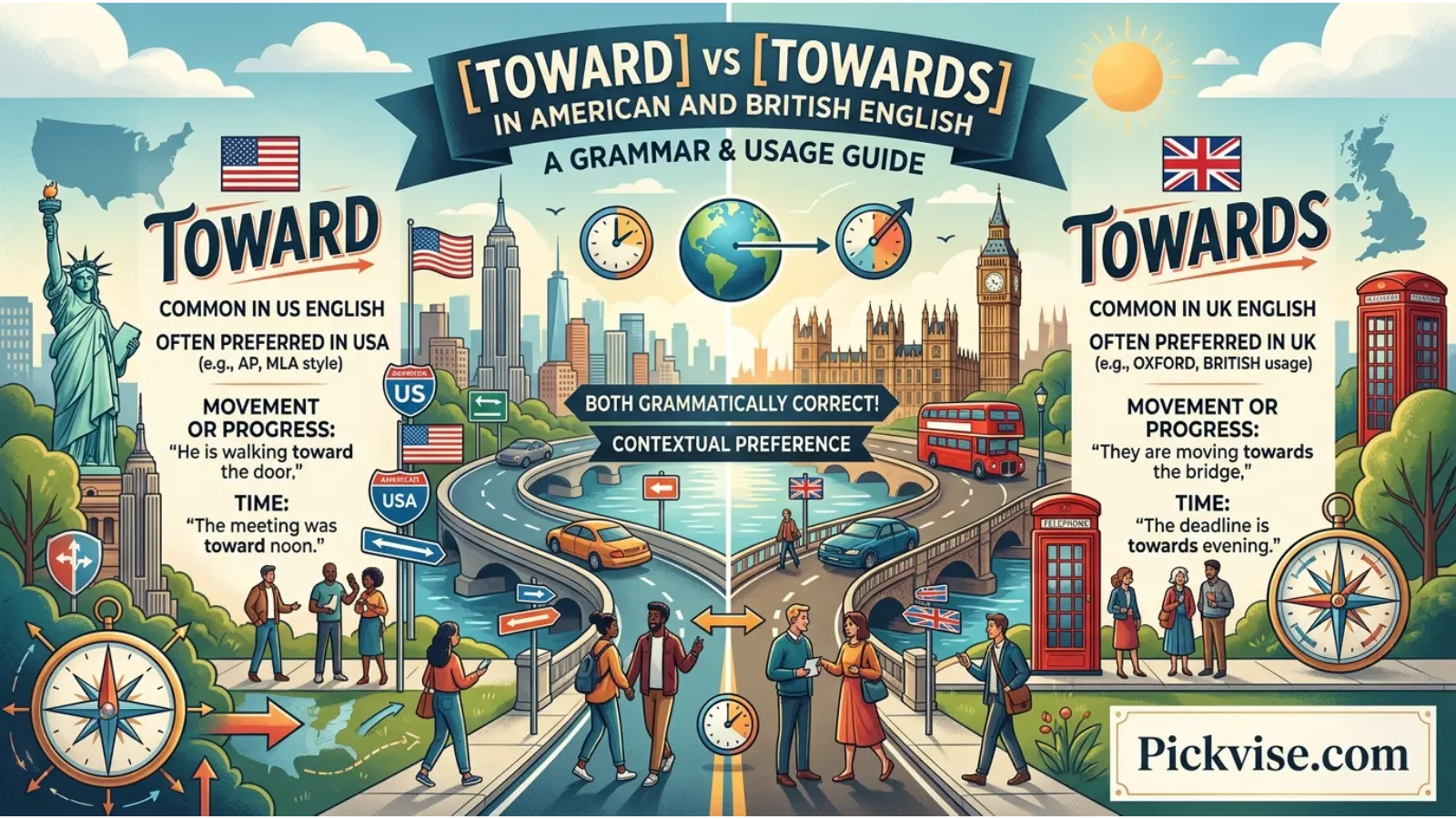
American English usually drops the final s.
American English
Examples:
- Walk toward the door.
- Move toward your goal.
- Look toward the future.
British English often keeps the s.
British English
Examples:
- Walk towards the station.
- Move towards success.
- She smiled towards her friend.
Neither version changes the meaning.
When Should You Use Toward?
Use toward if you write for an American audience.
Examples:
- The dog ran toward its owner.
- Our team worked toward victory.
- Turn toward the left.
- Everyone looked toward the stage.
This spelling appears in most American newspapers, books, and websites.
When Should You Use Towards?
Use towards if you write for readers in the UK, Australia, or New Zealand.
Examples:
- She walked towards the beach.
- The company is moving towards growth.
- We drove towards the city.
- They looked towards the mountains.
This spelling is common in British publications.
Real-Life Examples of Toward and Towards
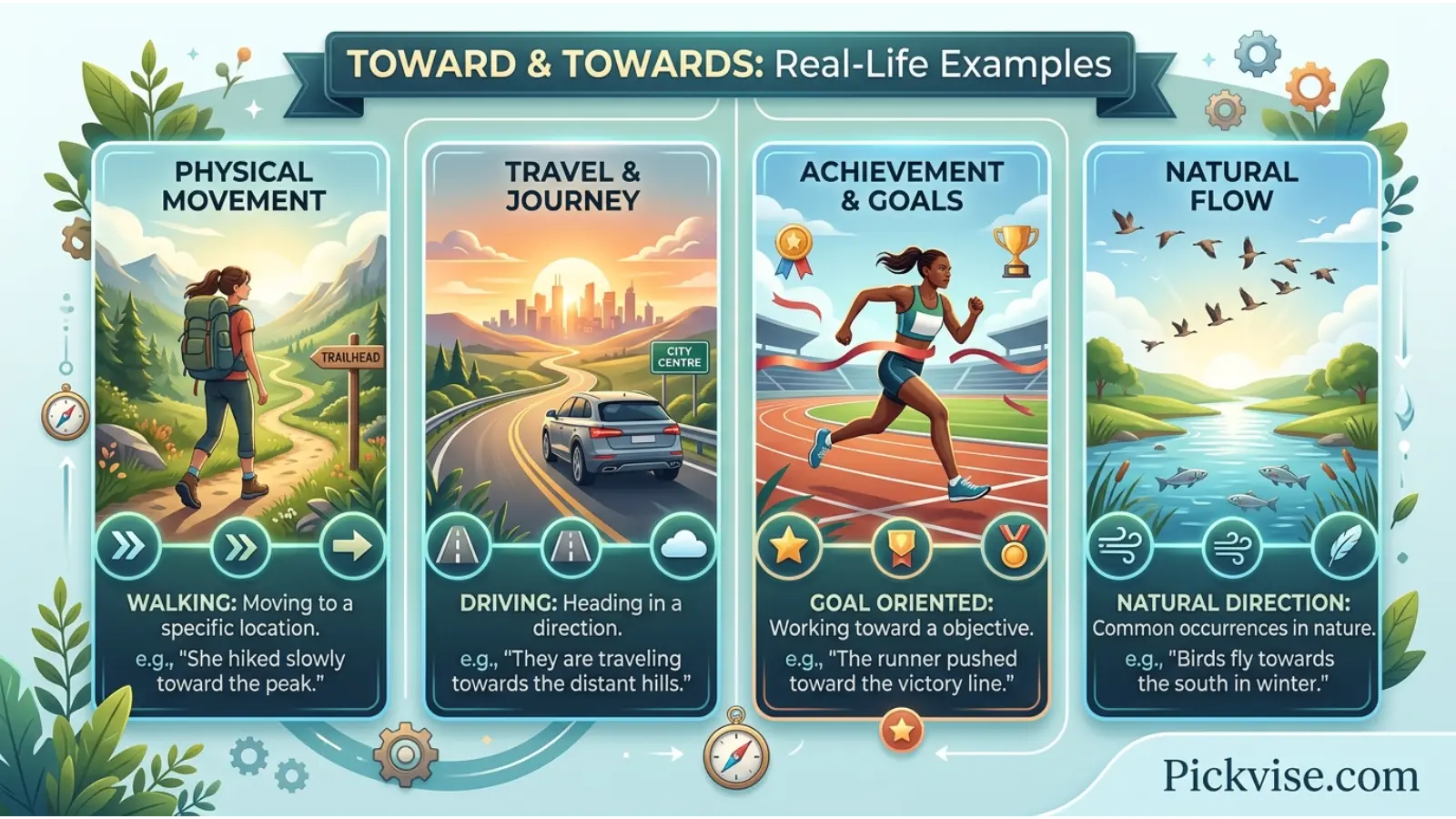
Here are everyday examples.
Talking about direction
- Walk toward the exit.
- Run towards the gate.
Talking about goals
- We are working toward a better future.
- They are moving towards success.
about attitude
- She feels kindness toward animals.
- He showed respect towards his teacher.
Talking about time
- As we move toward winter, temperatures drop.
- Towards the end of the meeting, everyone agreed.
Common Mistakes to Avoid
Many learners confuse spelling with grammar.
Avoid these mistakes.
Mixing styles
❌ American article using toward and towards randomly.
✔ Choose one style.
Thinking one is wrong
❌ Only “toward” is correct.
✔ Both are correct.
Using them as different meanings
❌ Toward means direction while towards means attitude.
✔ Both share identical meanings.
Switching spellings in one document
Stay consistent throughout your writing.
Easy Trick to Remember
Use this simple rule.
- Writing for the United States? Use toward.
- Writing for the United Kingdom? Use towards.
If your audience is international, either spelling works. Just stay consistent.
Toward or Towards in Daily Life
You hear these words every day.
Examples include:
- Walk toward the office.
- Drive towards home.
- Work toward your dreams.
- Show respect towards others.
- Look toward the future.
- Move towards your destination.
They appear in conversations, books, emails, news articles, and business writing.
Synonyms
Depending on the sentence, these words may replace toward or towards.
Synonyms
- In the direction of
- Near
- Close to
- Facing
- Approaching
- Toward the direction of
Expert Insight
Professional editors focus on consistency.
If you follow the Associated Press (AP) Stylebook or most American style guides, choose toward.
If you follow British publishing standards, use towards.
Search engines treat both spellings as valid. However, matching your audience’s preferred spelling improves readability and user experience.
For international websites, consistency matters more than the spelling itself.
Featured Snippet: Toward vs Towards
Toward and towards have the same meaning. Both indicate direction, movement, or attitude. The only difference is regional preference. Toward is more common in American English, while towards is preferred in British English. Both spellings are grammatically correct.
Common Situations Where People Get Confused
Emails
American company:
- Please move toward the next step.
British company:
- Please move towards the next stage.
School Writing
Follow your teacher’s preferred English style.
Business Writing
Use the spelling that matches your company’s style guide.
Blogs
Write consistently for your target audience.
FAQs
Is toward or towards more correct?
Neither is more correct. Both are grammatically correct.
Is toward American English?
Yes. Toward is the preferred spelling in American English.
Is towards British English?
Yes. Towards is more common in British English.
Do toward and towards have different meanings?
No. They have exactly the same meaning.
Can I use both in the same article?
It is better to choose one spelling and stay consistent.
Which spelling should students use?
Use the spelling required by your school or teacher.
Does Google prefer toward or towards?
No. Google recognizes both spellings. Use the one your audience expects.
Which spelling should international websites use?
Either works. Consistency is more important than the choice itself.
Conclusion
Toward or Towards is not a question of right or wrong. Both spellings are correct and share the same meaning. The main difference is regional preference. American English usually uses toward, while British English prefers towards. Always consider your audience before choosing a spelling. Most importantly, stay consistent throughout your writing. Once you understand this simple rule, you can use either word with confidence in conversations, emails, essays, and professional writing.