Response or Respond are two important English words used in daily communication.
Many learners confuse them in writing and speaking.
A response or respond helps you communicate clearly in real life.
You use them in emails, messages, conversations, and formal writing.
“Response” is usually a noun.
“Respond” is usually a verb.
Both words are closely related in meaning.
But their usage is different in sentences.
This guide will explain everything in simple English.
You will learn meanings, differences, examples, and common mistakes.
You will also see real-life usage and easy tips.
By the end, you will use both words with confidence.
Quick Summary Box
- Response = A reply or answer (noun)
- Respond = To reply or answer (verb)
- Used in communication, emails, and conversations
- Common in formal and informal English
- Easy to confuse but simple to learn
- Proper usage improves writing clarity
Meaning of Response or Respond
Response or respond both relate to answering something.
- Response means a reply or reaction.
- Respond means to give a reply or reaction.
Example:
- Your response was quick.
- Please respond to the message.
Both words show communication between people.
Simple Explanation in Easy Words
Think like this:
- Response = Answer (thing)
- Respond = Doing the answer (action)
If someone asks a question:
- The answer is your response
- You respond by giving the answer
This makes learning very simple.
Response vs Respond: Key Difference
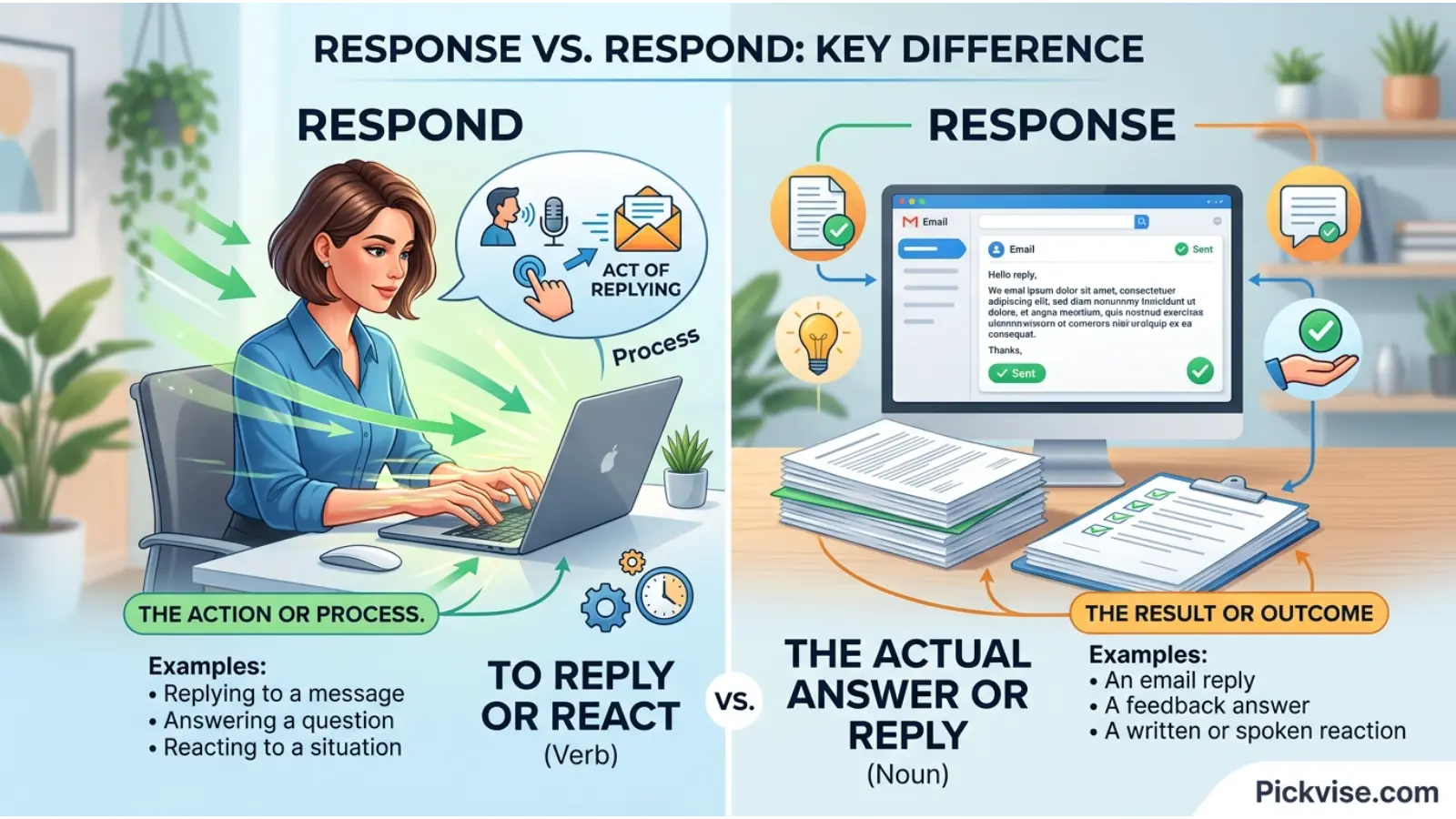
Here is a clear comparison:
| Feature | Response | Respond |
|---|---|---|
| Word Type | Noun | Verb |
| Meaning | Reply or answer | To reply or answer |
| Usage | Shows result | Shows action |
| Example | His response was slow | He will respond soon |
| Sentence Role | Object | Action |
This table helps you avoid confusion easily.
Real-Life Examples
Here are simple real-life examples:
- I got no response from him.
- Please respond to my email.
- Her response made everyone happy.
- They did not respond on time.
In daily life, you use both words often.
When to Use “Response”
Use response when talking about a reply as a thing.
Common uses:
- Email response
- Quick response
- Customer response
- Survey response
Examples:
- The company gave a fast response.
- I liked your response to the question.
It always works as a noun.
When to Use “Respond”
Use respond when talking about action.
Common uses:
- Respond quickly
- Respond to messages
- Respond to questions
- Respond politely
Examples:
- Please respond as soon as possible.
- She did not respond to the call.
It always works as a verb.
Common Mistakes
Many learners make these mistakes:
- Using “response” as a verb
- Using “respond” as a noun
- Mixing both in one sentence
- Wrong grammar structure
Wrong:
- He response late. ❌
Correct:
- He responds late. ✔
Wrong:
- I did a respond. ❌
Correct:
- I gave a response. ✔
Tips to Use Correctly
Follow these simple tips:
- Use response for things
- Use respond for actions
- Check sentence structure
- Practice with daily examples
- Read English messages carefully
This will improve your grammar quickly.
Usage in Daily Life

You see these words everywhere:
- WhatsApp messages
- Emails
- Office communication
- Social media replies
- Customer service chats
Example:
- “Thanks for your response.”
- “Kindly respond by today.”
These are very common in real life.
Synonyms
Synonyms for Response:
- Reply
- Answer
- Reaction
- Feedback
- Reply message
for Respond:
- Reply
- Answer back
- React
- Reply to
- Acknowledge
LSI Keywords:
- English grammar usage
- noun vs verb difference
- communication words
- email writing skills
- daily English phrases
Expert Insights (EEAT Section)
Understanding response or respond improves communication clarity.
In professional writing, correct usage builds trust.
It also improves your English fluency.
Experts recommend:
- Learning word roles first (noun/verb)
- Practicing real-life sentences
- Reading professional emails
This topic is important because communication is key in every job.
Clear grammar helps you sound more professional and confident.
FAQs
1. What is the difference between Reply and respond?
Response is a noun, respond is a verb.
2. Can I use response as a verb?
No, it is only a noun.
3. Can respond be used in formal writing?
Yes, it is commonly used in formal English.
4. What is a simple example of response?
“His response was good.”
5. What is a simple example of respond?
“Please respond quickly.”
6. Are reply and respond the same?
No, they are related but different in usage.
7. Which is more common in daily English?
Both are common, depending on sentence use.
Conclusion
Response or respond are essential English grammar words.
They help in clear communication in daily life.
The word response is a noun.
It shows a reply or answer.
The word respond is a verb.
It shows the action of replying.
Understanding the difference improves your writing skills.
It also helps you avoid grammar mistakes.
You use both words in emails, chats, and conversations.
With practice, you will use them correctly without confusion.
Always remember:
- Response = thing (noun)
- Respond = action (verb)
Mastering this simple difference will make your English stronger and more professional.