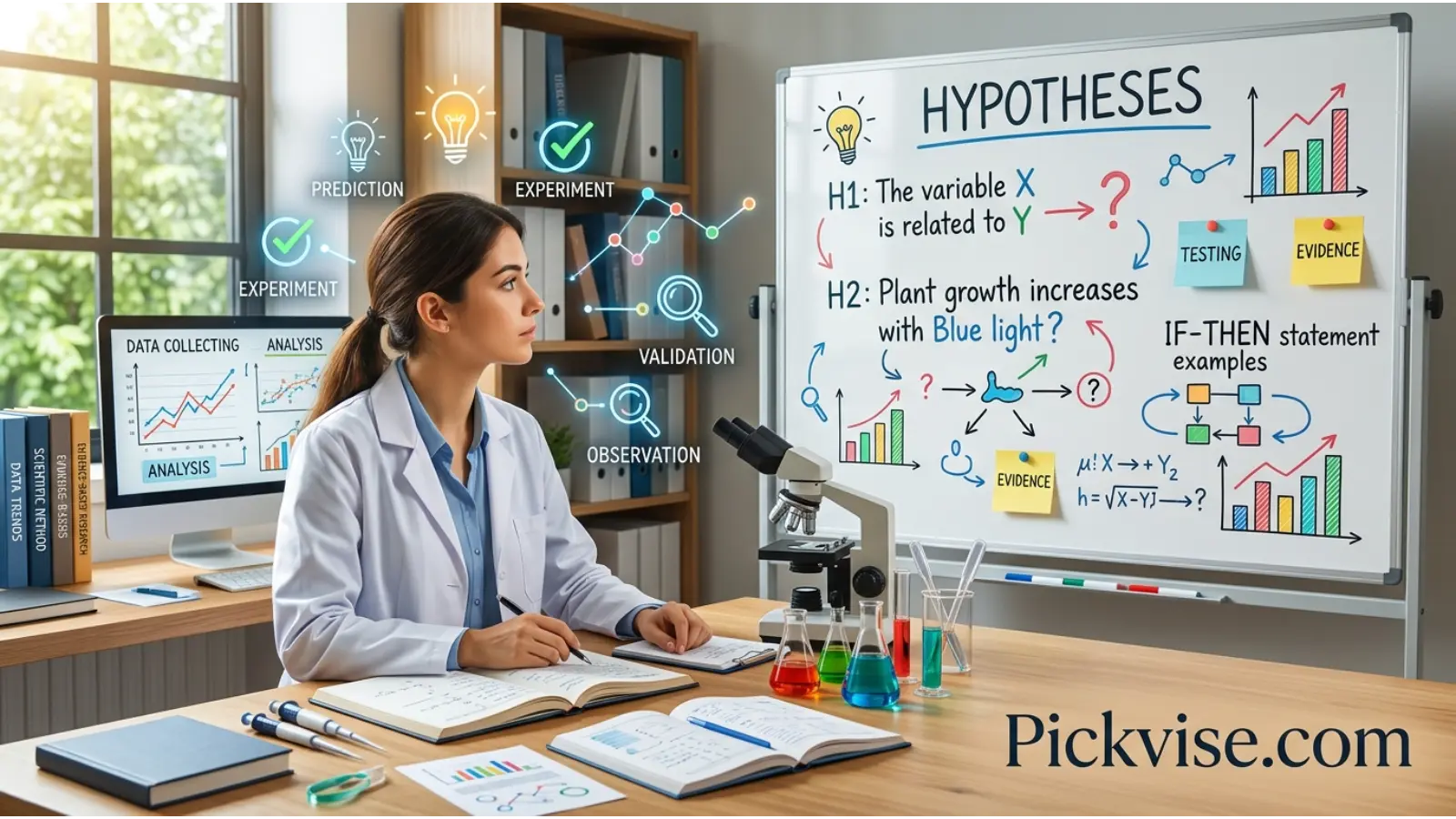
Hypothesis or Hypotheses means a smart guess used in science and research.
A hypothesis helps us test ideas in a clear way.
In the first step, scientists make a hypothesis.
Then they test it using experiments.
This topic is very important in science, research, and studies.
It helps us understand how things work in the real world.
A hypothesis is not just any guess.
It must be tested and proven true or false.
In this article, you will learn the meaning, examples, rules, and uses of hypothesis.
Everything is explained in very simple English for easy understanding.
Quick Summary Box (Featured Snippet)
- A hypothesis is a testable idea or smart guess
- It is used in science and research
- Scientists test it with experiments
- It can be proven true or false
- “Hypotheses” is the plural form of hypothesis
- It helps explain how things might work
- It is based on logic and observation
What is a Hypothesis? (Meaning)
A hypothesis is a simple idea that can be tested.
It is used to explain something we do not fully know.
Scientists make a hypothesis before doing experiments.
It helps them predict results.
A hypothesis must be clear and testable.
It cannot be random thinking.
Simple Definition of Hypothesis
A hypothesis is a testable statement that predicts a possible result.
It is based on facts, observations, or logic.
It is not a final answer.
Hypothesis vs Hypotheses (Simple Difference)
| Singular | Plural |
|---|---|
| Hypothesis | Hypotheses |
| One idea | More than one idea |
| Example: One experiment idea | Example: Many experiment ideas |
| Used in single case | Used in multiple cases |
The word “hypotheses” simply means more than one hypothesis.
How Does a Hypothesis Work?
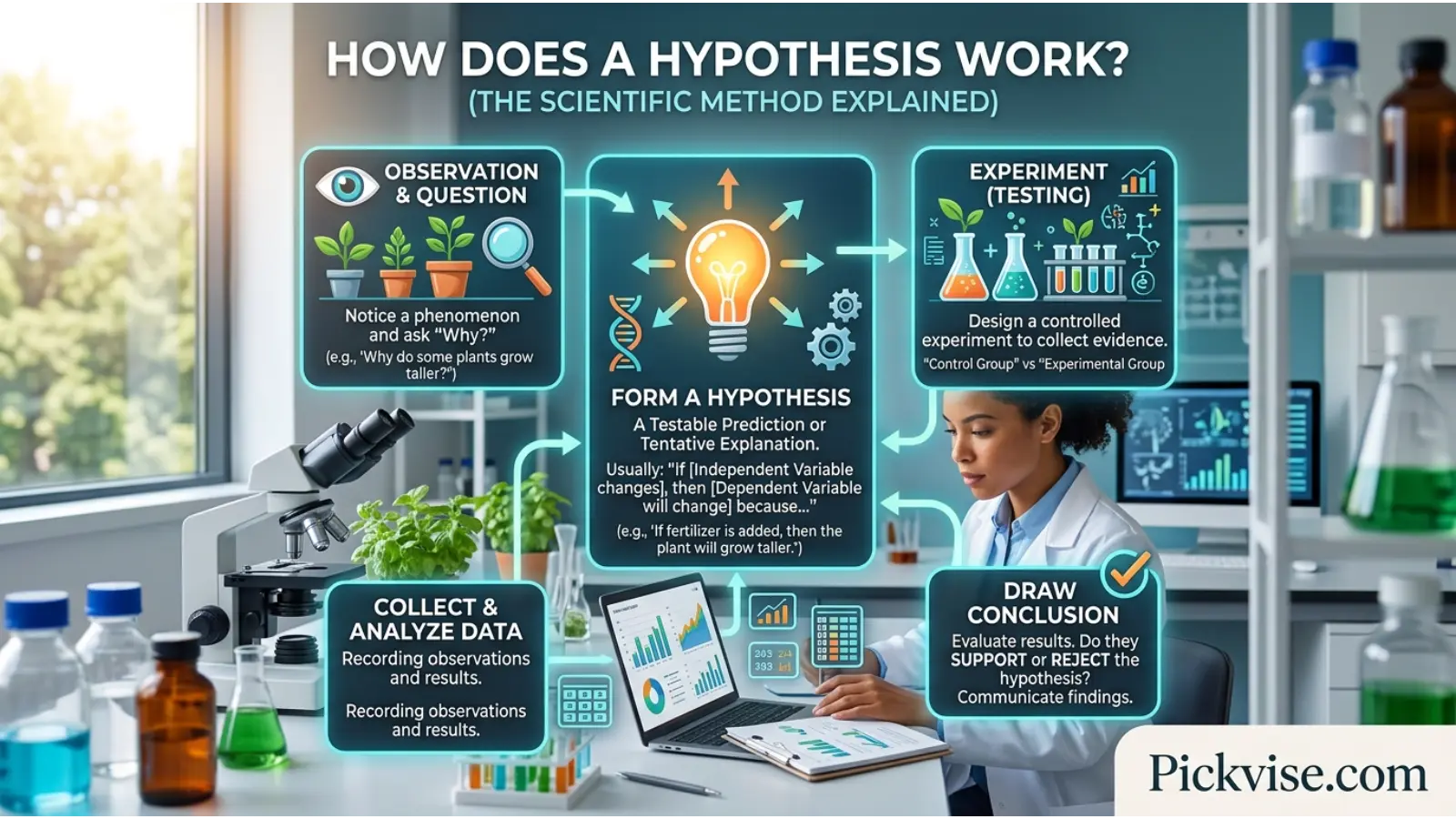
A hypothesis works like a starting point in research.
First, you observe something.
Then you make a guess about it.
After that, you test your guess using experiments.
Finally, you check if your idea is correct or not.
This process helps scientists learn new facts.
Real-Life Examples of Hypothesis
Here are simple examples:
- If plants get more sunlight, they grow faster.
- If you study more, you get better marks.
- If it rains, the ground becomes wet.
- If you eat healthy food, you stay strong.
Each example can be tested.
That is why they are hypotheses.
Types of Hypothesis
There are different types of hypotheses:
1. Simple Hypothesis
It predicts a relationship between two things.
2. Complex Hypothesis
It includes more than two variables.
3. Null Hypothesis
It says there is no effect or relationship.
4. Alternative Hypothesis
It says there is a real effect or relationship.
Why is Hypothesis Important?
A hypothesis is very important in science.
It helps in:
- Starting research
- Guiding experiments
- Saving time
- Finding answers
- Understanding problems
Without a hypothesis, research becomes unclear.
Common Mistakes in Hypothesis Writing
Many students make mistakes like:
- Making it too long
- Not making it testable
- Using unclear language
- Adding opinions instead of facts
- Not focusing on one idea
Avoid these mistakes for better results.
Tips to Write a Good Hypothesis
Here are simple tips:
- Keep it short and clear
- Make it testable
- Use simple words
- Focus on one idea
- Base it on observation
- Avoid guessing without reason
A good hypothesis is always easy to test.
Hypothesis in Daily Life
We use hypothesis in daily life without knowing it.
Examples:
- If I leave early, I will reach on time
- If I practice more, I will improve
- If I sleep late, I will feel tired
These are small real-life predictions.
They work like informal hypotheses.
Synonyms
You may also see these related terms:
- Smart guess
- Scientific guess
- Testable idea
- Prediction
- Research idea
- Assumption (not always correct)
- Scientific statement
- Experimental idea
These help improve SEO understanding.
Comparison Table: Hypothesis vs Theory
| Hypothesis | Theory |
|---|---|
| Early idea | Final explanation |
| Needs testing | Already tested many times |
| Not proven | Strong evidence |
| Changes easily | More stable |
| Starting point | Final result |
A hypothesis can become a theory after many tests.
Expert Insights (EEAT Section)
Experts say a hypothesis is the heart of science.
It guides every experiment and discovery.
Without a hypothesis, research becomes random.
Scientists cannot find clear answers.
That is why every scientific study starts with a strong hypothesis.
It improves accuracy and saves time.
Understanding hypothesis also improves critical thinking skills.
It helps students think logically and clearly.
FAQs About Hypothesis or Hypotheses
1. What is a simple definition of hypothesis?
A hypothesis is a testable idea or smart guess.
2. What is the plural of hypothesis?
The plural is hypotheses.
3. Is a hypothesis always true?
No, it can be true or false after testing.
4. Where is hypothesis used?
It is used in science, research, and experiments.
5. Can a hypothesis change?
Yes, it can change after new results.
6. What makes a good hypothesis?
It should be clear, simple, and testable.
7. Is hypothesis same as theory?
No, a theory is proven. A hypothesis is still being tested.
Conclusion
A hypothesis or hypotheses is a very important part of learning and research.
It helps us make smart guesses that can be tested.
A hypothesis is always based on logic and observation.
It is the first step in scientific discovery.
We also learned that hypotheses means more than one hypothesis.
This concept is used in science, education, and daily life.
In simple words, a hypothesis helps us explore answers before knowing the truth.
It improves thinking, learning, and problem-solving skills.