
Second or Secondly is a common grammar topic that confuses many English learners. Both words help organize ideas, but they are not always used in the same way. Knowing when to use each one makes your writing clearer and more natural.
Many people wonder whether they should say second or secondly in a speech, essay, or email. The good news is that the rule is simple. Once you understand the difference, you can use both words with confidence.
This guide explains the meaning of each word in easy English. You will also learn the grammar rules, common mistakes, and real-life examples. By the end, you will know exactly when to use second and when secondly is the better choice.
Quick Summary
- Second and secondly both introduce the second point in a list.
- Second is more common in modern English.
- Secondly is more formal and traditional.
- Both forms are grammatically correct.
- Stay consistent throughout your writing.
- Use second for simple and natural writing.
- Use secondly in formal speeches or academic writing if it matches your style.
What Does “Second” Mean?
Second introduces the second idea, reason, or step in a sequence.
It works as an ordinal number and also as a transition word.
Examples
- First, wash your hands. Second, dry them well.
- I have two reasons. Second, the cost is too high.
- Second, we need better planning.
In modern English, second sounds natural and is the preferred choice for most writing.
What Does “Secondly” Mean?
Secondly is an adverb that introduces the second point in a list.
It has the same purpose as second, but it sounds more formal.
Examples
- Firstly, we need a plan. Secondly, we need a budget.
- Secondly, the report lacks evidence.
- She explained the problem. Secondly, she suggested a solution.
Many academic writers still use secondly, especially when they also use firstly.
Second vs Secondly: What’s the Difference?
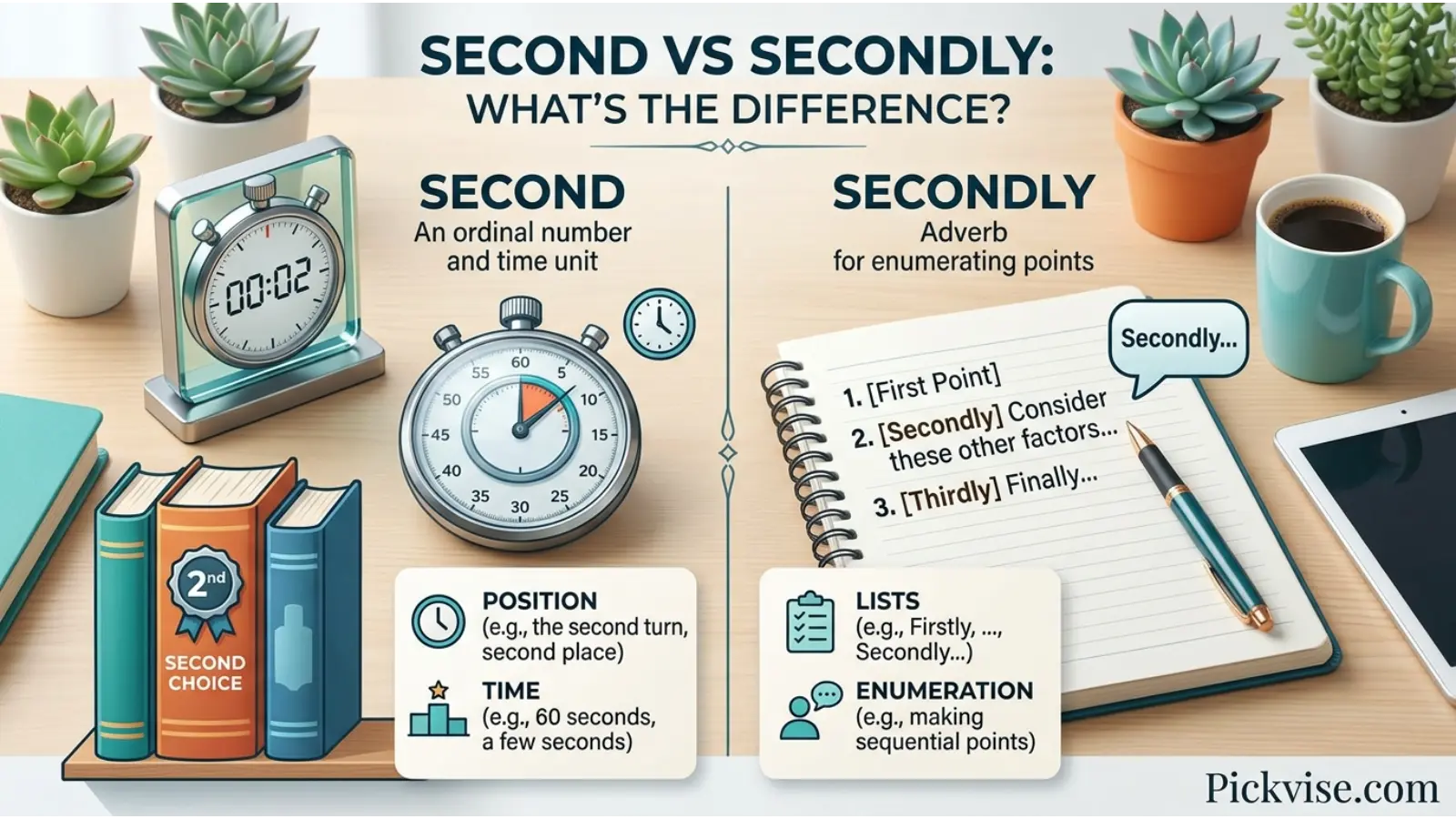
The main difference is style, not meaning.
Both words introduce the second point in a list. However, second is more common in everyday English. Secondly appears more often in formal writing and speeches.
Choose one style and use it throughout your writing.
For example:
✔ First, check the facts. Second, write your answer.
✔ Firstly, check the facts. Secondly, write your answer.
Avoid mixing the two styles in the same list.
❌ Firstly… Second…
✔ First… Second…
✔ Firstly… Secondly…
Second or Secondly: Comparison Table
| Feature | Second | Secondly |
|---|---|---|
| Part of speech | Ordinal word used as a transition | Adverb |
| Meaning | Introduces the second point | Introduces the second point |
| Common in modern English | ✅ Yes | Less common |
| Formality | Neutral | More formal |
| Best for | Everyday writing | Academic writing and speeches |
| Easy to read | ✅ Yes | Yes |
| Grammatically correct | ✅ Yes | ✅ Yes |
When Should You Use “Second”?
Use second when you want your writing to sound simple, clear, and natural.
It works well in:
- Blog posts
- Emails
- Business writing
- School assignments
- Everyday conversations
- Online articles
Examples
- First, read the instructions. Second, answer the questions.
- We need more workers. Second, we need better equipment.
- Second, the results were unexpected.
Most style guides prefer second because it sounds smoother and easier to read.
Why Do Many Writers Prefer “Second”?
Many modern writers choose second because it is shorter and more natural.
It improves readability and keeps sentences simple. Readers understand it quickly, especially in blogs, websites, and business content.
Using second also matches common transition words like:
- First
- Next
- Then
- Finally
This creates a smooth flow without making the writing sound overly formal.
When Should You Use “Secondly”?
Use secondly when your writing follows a formal style or when you have already started with firstly. It helps keep your list consistent.
You will often see secondly in:
- Academic papers
- Research reports
- Formal speeches
- Legal writing
- Professional presentations
Examples
- Firstly, we reviewed the data. Secondly, we compared the results.
- The proposal has two strengths. Secondly, it saves money.
- Secondly, the new policy improves customer service.
Although secondly is correct, many modern style guides prefer second because it sounds more natural.
Real-Life Examples of Second and Secondly
Here are some everyday examples to show how both words work.
Example 1: School
✅ First, read the chapter. Second, answer the questions.
Example 2: Cooking
✅ First, heat the pan. Second, add the oil.
Example 3: Business Meeting
✅ Firstly, let’s discuss sales. Secondly, we’ll review customer feedback.
Example 4: Presentation
✅ First, I’ll explain the problem. Second, I’ll share the solution.
Example 5: Essay
✅ Firstly, pollution harms wildlife. Secondly, it affects human health.
Common Mistakes to Avoid
Many learners make small mistakes when using second and secondly. Here are the most common ones.
1. Mixing Styles
❌ Firstly, we planned the project. Second, we started work.
✔ Firstly, we planned the project. Secondly, we started work.
OR
✔ First, we planned the project. Second, we started work.
2. Using Too Many Transition Words
❌ First, firstly, second, secondly…
✔ First, second, third…
OR
✔ Firstly, secondly, thirdly…
3. Thinking One Is Wrong
Some people believe secondly is incorrect.
That’s not true.
Both second and secondly are grammatically correct.
4. Using Them Without a List
These words introduce numbered ideas.
If there is no sequence, choose another transition word instead.
How to Remember the Difference
These simple tips make the choice easy.
- Use second for everyday writing.
- Use secondly when you already use firstly.
- Keep the same style throughout your list.
- Read your sentence aloud. Choose the word that sounds more natural.
- Avoid switching between styles.
A simple trick is:
First → Second
Firstly → Secondly
Using Second and Secondly in Daily Life

You can use these words in many situations.
At School
- First, finish your homework. Second, check your answers.
Work
- First, reply to emails. Second, attend the meeting.
Home
- First, clean the kitchen. Second, wash the dishes.
During a Speech
- Firstly, I’d like to thank everyone.
- Secondly, I’d like to explain today’s goals.
In Blog Posts
Many bloggers prefer second because it sounds simple and conversational.
Synonyms
These words have similar purposes depending on the sentence.
Synonyms
- Next
- Then
- After that
- Following that
- Subsequently
- Furthermore
- Also
- Moreover
- In addition
- Finally
Related Search Terms
- second vs secondly
- when to use second
- when to use secondly
- secondly meaning
- second meaning in grammar
- transition words
- sequence words
- English grammar guide
- first second third grammar
- firstly secondly rules
Using these naturally improves SEO without overusing the main keyword.
Expert Insights
Grammar experts agree that both second and secondly are correct. The difference is mainly one of style.
Modern writing usually favors second because it is shorter and easier to read. It fits well in blogs, emails, and business writing.
Secondly remains common in formal writing, academic papers, and speeches. If you begin with firstly, using secondly keeps your writing consistent.
The best approach is to choose one style and stick with it throughout your document. Consistency makes your writing look polished and professional.
Frequently Asked Questions (FAQs)
Is “secondly” grammatically correct?
Yes. Secondly is completely correct and is often used in formal writing.
Should I use “second” or “secondly”?
Use second for most everyday writing. Use secondly if you have already used firstly or if you want a more formal tone.
Is “second” more common than “secondly”?
Yes. Second is more common in modern English because it sounds simpler and more natural.
Can I say “firstly” and “second”?
It is better not to. Use either first–second or firstly–secondly for consistency.
Which is better for academic writing?
Both are acceptable. However, many academic writers use firstly and secondly together.
Can I use “secondly” in conversation?
Yes, but it may sound more formal than second. Most people simply say second in everyday speech.
Are “second” and “secondly” interchangeable?
In most lists, yes. The meaning is the same, but the tone is different.
Conclusion
Understanding Second or Secondly is easier than many people think. Both words introduce the second point in a list, and both are grammatically correct. The main difference is style. Second is the preferred choice in modern English because it sounds clear, simple, and natural. Secondly is more formal and often appears in academic writing, speeches, and professional documents.
The most important rule is to stay consistent. If you start with first, continue with second. If you begin with firstly, follow it with secondly. By applying these simple rules, your writing will become more polished, readable, and professional.