Complements or Compliments often confuse English learners and even native speakers. These two words sound the same, but they have different meanings. Many people use one when they actually mean the other. As a result, their writing becomes incorrect.
The good news is that the difference is easy to learn. Once you understand each word, you will never mix them up again.
In this guide, you will learn the meaning of complements and compliments in simple English. You will also see comparison tables, real-life examples, common mistakes, memory tricks, and expert tips. By the end, you will know exactly when to use each word with confidence.
Quick Summary
- Complement means something that completes or improves something else.
- Compliment means praise, admiration, or kind words.
- Both words sound the same but have different meanings.
- Complement relates to completion.
- Compliment relates to praise.
- Learning the difference improves your English writing.
What Does “Complement” Mean?
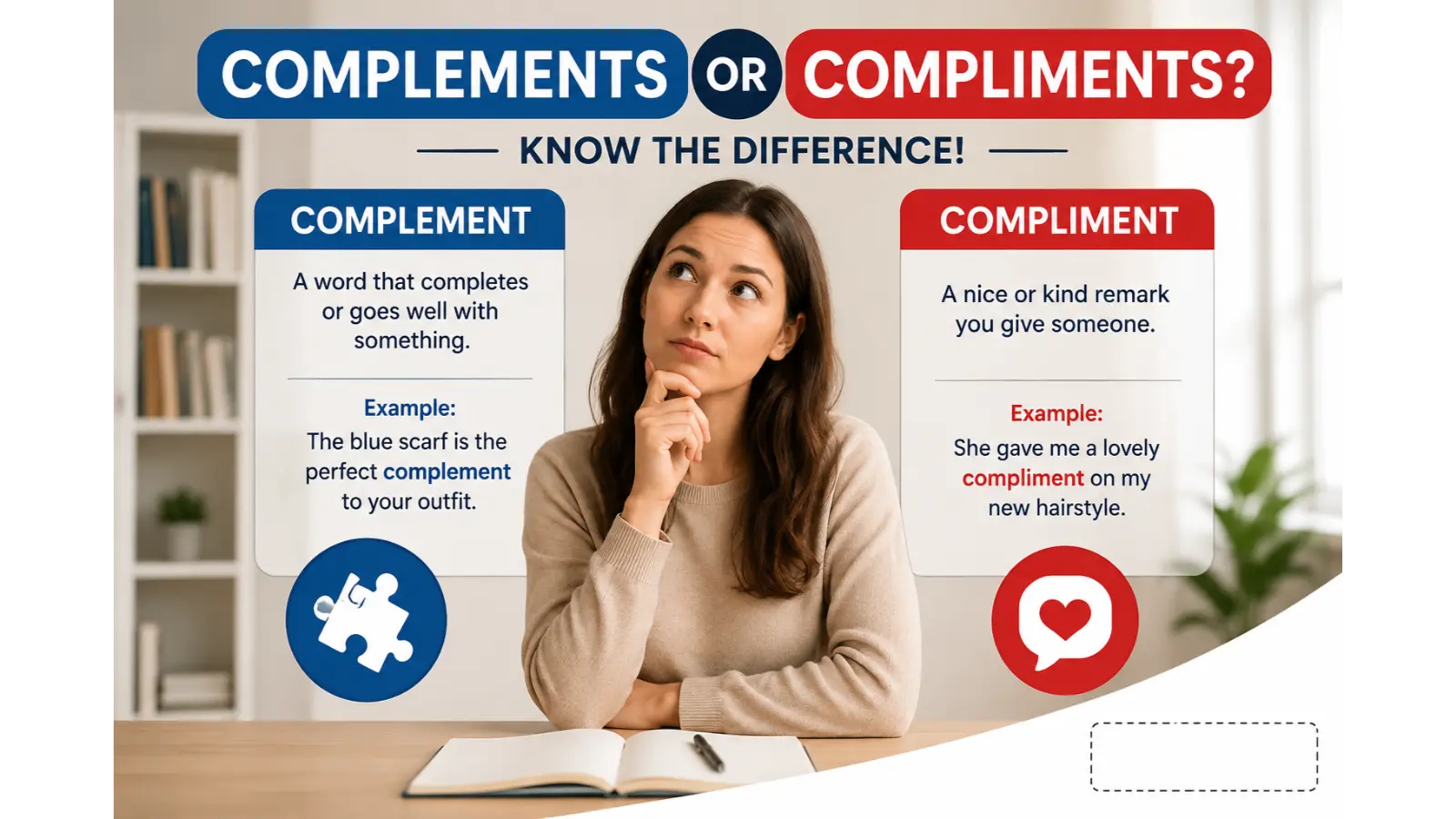
A complement is something that completes, matches, or makes another thing better.
It adds value or improves something.
Simple Definition
Complement = Something that completes or enhances another thing.
Examples
- The red tie complements his black suit.
- Fresh bread complements the soup.
- Her skills complement the team’s experience.
- Lemon complements grilled fish.
In each example, one thing improves another.
What Does “Compliment” Mean?
A compliment is a kind or positive remark about someone.
It shows praise or admiration.
Simple Definition
Compliment = A polite expression of praise or admiration.
Examples
- She gave me a compliment about my presentation.
- Thank you for the compliment.
- He complimented her beautiful painting.
- The teacher complimented the students for working hard.
Here, people are giving praise.
Complements vs. Compliments: Key Differences
| Feature | Complement | Compliment |
|---|---|---|
| Meaning | Completes or improves | Praises someone |
| Related Idea | Completion | Praise |
| Part of Speech | Noun and Verb | Noun and Verb |
| Example | Cheese complements pizza. | She gave me a compliment. |
| Easy Memory | Complete | Praise |
Why Do People Confuse Complements and Compliments?
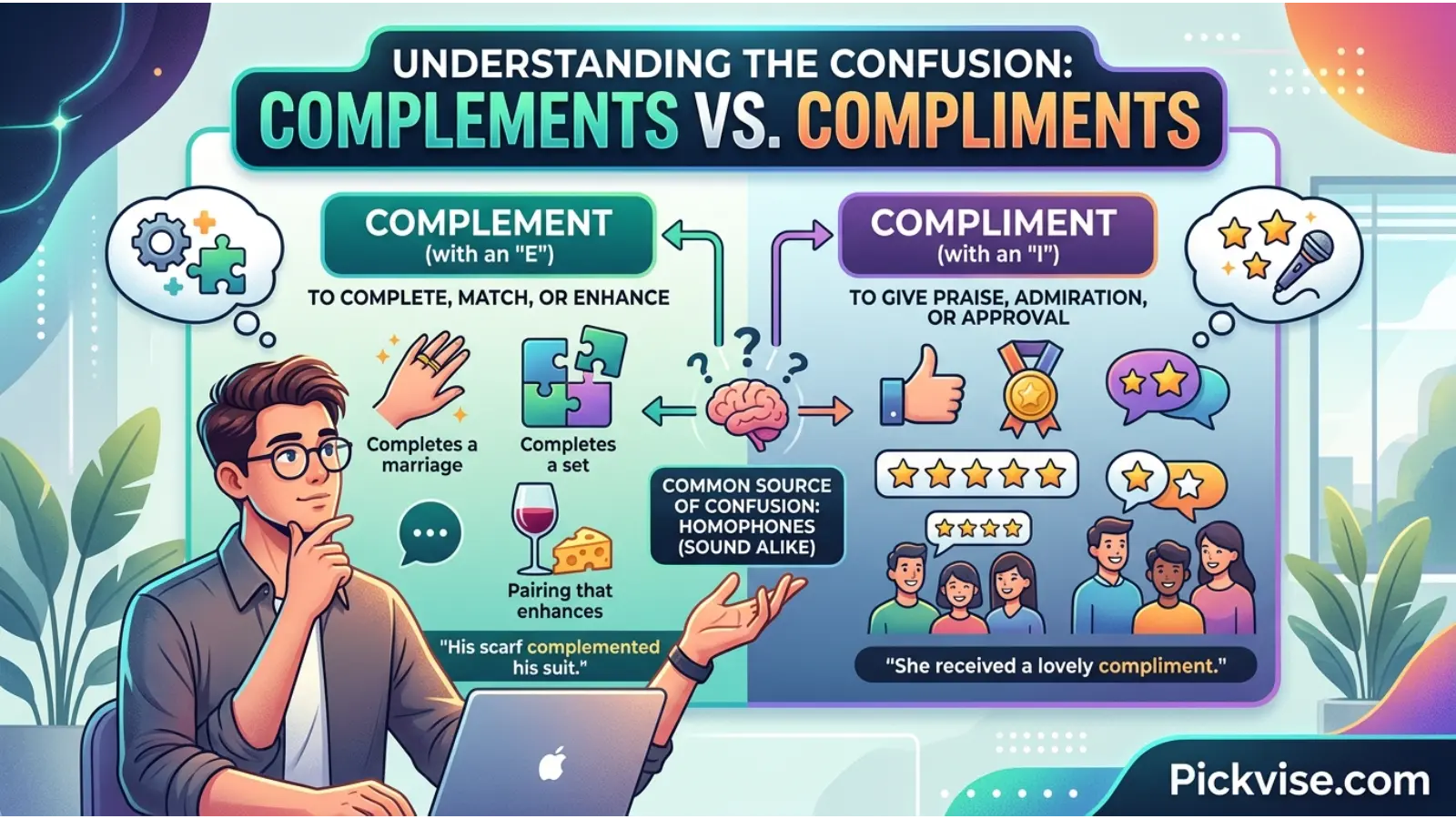
There are several reasons.
- They sound exactly the same.
- Only one letter changes.
- Both appear in everyday writing.
- Spell-check does not always catch the mistake.
- Many people learn them through speaking first.
Because of this, writers often choose the wrong spelling.
Real-Life Examples of Complement and Compliment
Example 1
✔ Your shoes complement your outfit.
The shoes make the outfit look better.
Example 2
✔ She gave you a nice compliment.
She praised you.
Example 3
✔ Garlic complements tomato sauce.
Garlic improves the flavor.
Example 4
✔ My boss complimented my work.
My boss praised me.
Example 5
✔ Blue complements green in many designs.
The colors work well together.
Complement as a Verb
The verb complement means to improve or complete something.
Examples
- These colors complement each other.
- His experience complements his education.
- Fresh herbs complement the meal.
- This software complements our existing tools.
Compliment as a Verb
The verb compliment means to praise someone.
Examples
- I complimented her cooking.
- They complimented the new employee.
- Everyone complimented his speech.
- She complimented me on my haircut.
Common Mistakes People Make
Many writers confuse the spellings.
Incorrect
- She gave me a complement.
Correct
- She gave me a compliment.
Incorrect
- These colors compliment each other.
Correct
- These colors complement each other.
Incorrect
- I received many complements on my speech.
Correct
- I received many compliments on my speech.
Always ask yourself:
- Am I talking about praise?
- Or am I talking about making something better?
The answer tells you which word to choose.
Easy Memory Tricks
Remember these simple tips.
Complement = Complete
Both words begin with Comple-.
Think:
Complement helps complete something.
Compliment = Praise
Think about saying nice things to people.
A compliment makes someone smile.
Quick Trick
- Complete → Complement
- Praise → Compliment
This trick works almost every time.
Using Complement and Compliment in Daily Life
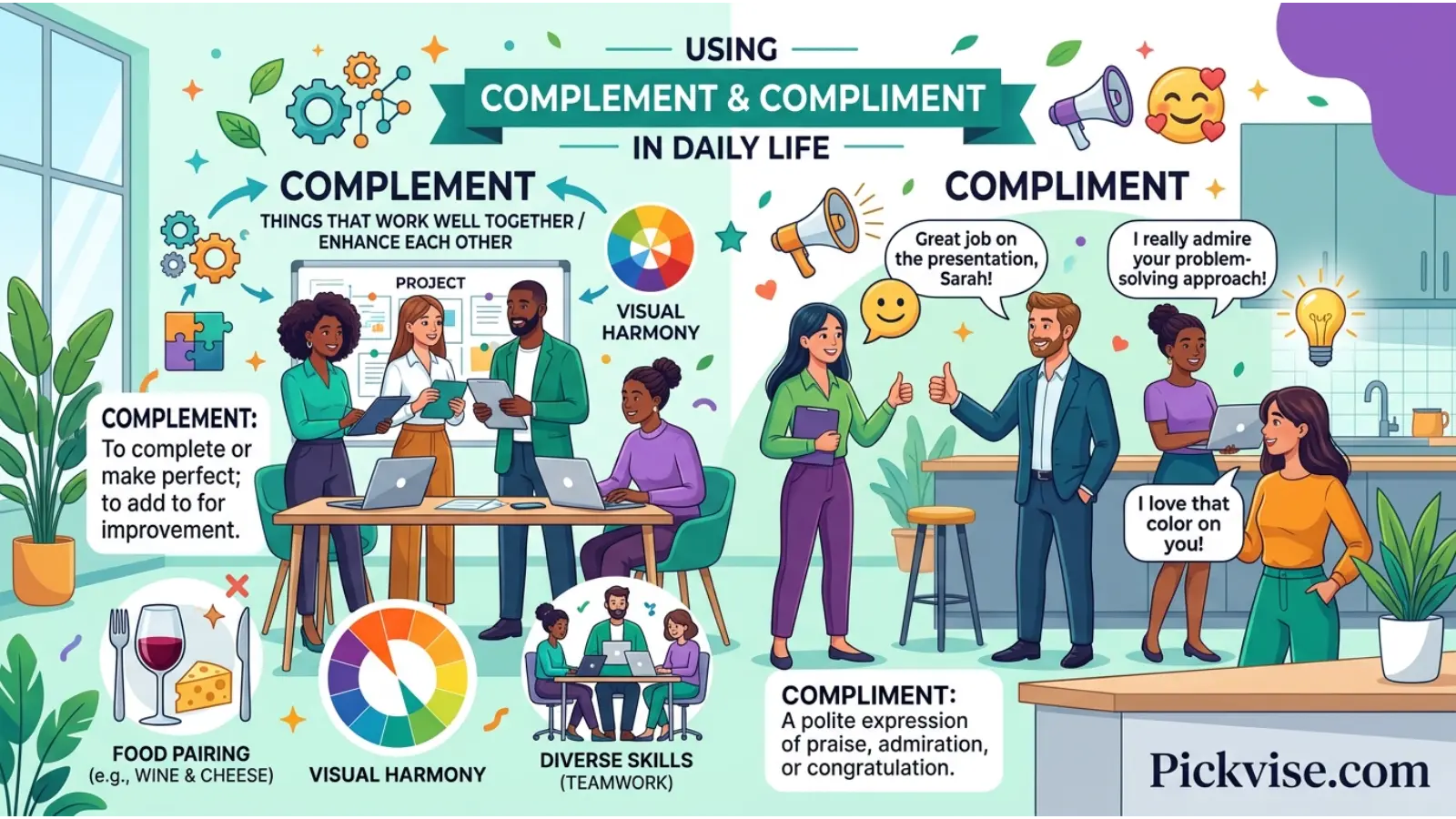
You can use these words every day.
At Work
- Your skills complement the team.
- Your manager complimented your presentation.
At School
- Your notes complement the textbook.
- The teacher complimented your homework.
Home
- Fresh flowers complement the living room.
- Your family complimented your cooking.
While Shopping
- These shoes complement your dress.
- The cashier complimented your jacket.
Using the correct word makes your English sound natural.
Synonyms and Related Words
Using related words naturally helps readers and improves SEO.
Synonyms of Complement
- Complete
- Enhance
- Improve
- Match
- Balance
- Go well with
- Support
- Strengthen
- Perfect
- Pair with
Example
- Fresh basil enhances pasta.
- Fresh basil complements pasta.
Both sentences have a similar meaning.
Synonyms of Compliment
- Praise
- Admiration
- Appreciation
- Flattery
- Kind words
- Positive remark
- Encouragement
- Approval
- Recognition
- Commendation
Example
- She praised my artwork.
- She gave me a compliment on my artwork.
Related SEO Keywords (LSI Keywords)
Use these naturally throughout your content.
- complement meaning
- compliment meaning
- complement vs compliment
- complements or compliments
- difference between complement and compliment
- complement examples
- compliment examples
- complement definition
- compliment definition
- when to use complement
- when to use compliment
- grammar mistakes
- confusing English words
- English vocabulary
- homophones in English
When Should You Use “Complement”?
Use complement when one thing makes another thing better.
Examples
- A belt complements the outfit.
- Good communication complements teamwork.
- Herbs complement roasted vegetables.
- Experience complements education.
Whenever something improves or completes another thing, use complement.
When Should You Use “Compliment”?
Use compliment when someone says something kind or positive.
Examples
- She complimented my new hairstyle.
- He received many compliments after his speech.
- My friend complimented my artwork.
- Everyone complimented the chef.
Whenever praise is involved, choose compliment.
Grammar Tips
Both words can be nouns and verbs.
Complement (Noun)
- This sauce is the perfect complement to steak.
Complement (Verb)
- The colors complement each other.
Compliment (Noun)
- Thank you for the compliment.
Compliment (Verb)
- She complimented me on my writing.
Understanding the grammar helps you avoid mistakes.
Examples in Sentences
Complement
- Coffee complements chocolate.
- White shoes complement blue jeans.
- Music complements the atmosphere.
- His creativity complements her planning.
- The curtains complement the furniture.
Compliment
- She received many compliments.
- I complimented his hard work.
- My parents complimented my cooking.
- The customer complimented the service.
- He smiled after the compliment.
Common English Expressions
These expressions appear often in books and conversations.
With Complement
- Perfect complement
- Complement each other
- Complement your style
- Complement the design
- Complement your skills
With Compliment
- Pay someone a compliment
- Receive a compliment
- Accept a compliment
- Give a compliment
- Compliment someone on something
Learning these phrases improves natural English.
Quiz: Test Your Understanding
Choose the correct word.
1.
Your scarf ______ your jacket.
Answer: complements
2.
She gave me a nice ______.
Answer: compliment
3.
The teacher ______ the students.
Answer: complimented
4.
Fresh herbs ______ the soup.
Answer: complement
5.
Everyone loved the speech and gave many ______.
Answer: compliments
If you answered all correctly, you understand the difference well.
Expert Insights
Many spelling mistakes happen because complement and compliment are homophones. They sound alike but carry different meanings.
Professional writers always check the context before choosing the spelling.
Ask yourself one simple question:
Am I talking about praise or improvement?
- If it is praise, use compliment.
- If it means making something complete or better, use complement.
This simple habit prevents almost every mistake.
Reading quality books and proofreading your writing also improve your grammar over time.
Frequently Asked Questions (FAQs)
What is the difference between complements and compliments?
A complement completes or improves something. A compliment is praise or kind words.
Are complement and compliment pronounced the same?
Yes. They are homophones. They sound the same but have different meanings and spellings.
Which word means praise?
Compliment means praise or admiration.
Which word means to improve something?
Complement means to complete, enhance, or improve something else.
Is “Your dress complements your shoes” correct?
Yes. The shoes and dress look good together, so complements is the correct word.
Is “Thank you for the complement” correct?
No. The correct sentence is:
Thank you for the compliment.
How can I remember the difference?
Remember this easy trick:
- Complete → Complement
- Praise → Compliment
This memory tip helps most learners remember the correct spelling.
Below is the final part of your SEO-optimized, WordPress-ready article.
Featured Snippet Box
What is the difference between complements and compliments?
A complement is something that completes, improves, or matches another thing. A compliment is a polite expression of praise or admiration. Although the two words sound the same, they have different meanings and spellings. Use complement for enhancement and compliment for praise.
Conclusion
Understanding the difference between complements or compliments is easier than it first appears. Although these words sound exactly the same, they serve different purposes. A complement improves, completes, or matches something else. A compliment expresses praise or admiration toward a person.
The easiest way to remember them is with a simple trick: complement relates to complete, while compliment relates to kind words. Whenever you write, think about the meaning before choosing the spelling.
With regular practice and real-life examples, you will quickly build confidence and avoid this common grammar mistake. Using the correct word makes your writing clearer, more professional, and easier for readers to understand.
Internal Linking Suggestions
Add links to related articles on your website to improve SEO and user experience.
- Affect vs. Effect
- Soul or Sole
- Field or Feild
- Finaly or Finally
- Fridge or Frige
- Liaison or Liason
- Possess or Posess
- Wreckless or Reckless
- Arctic Meaning
- Commonly Confused English Words
Image Alt Text Ideas
Use descriptive alt text for better accessibility and SEO.
- Complements vs Compliments comparison chart
- Difference between complements and compliments
- Complement and compliment examples
- Easy grammar guide for complements or compliments
- English vocabulary comparison
- Complement meaning with examples
- Compliment meaning explained
- Common English homophones
URL Slug
complements-or-compliments
Suggested H2 Structure
- What Does Complement Mean?
- What Does Compliment Mean?
- Complements vs. Compliments: Key Differences
- Comparison Table
- Why People Confuse These Words
- Real-Life Examples
- Complement as a Verb
- Compliment as a Verb
- Common Mistakes
- Memory Tricks
- Daily Usage
- Synonyms and Related Words
- Grammar Tips
- FAQs
- Expert Insights
- Conclusion
Primary Keyword
- Complements or Compliments
Secondary Keywords
- complement vs compliment
- complement meaning
- compliment meaning
- complements meaning
- compliments meaning
- difference between complement and compliment
- complement examples
- compliment examples
- when to use complement
- when to use compliment
- confusing English words
- English grammar guide
- English vocabulary
- homophones in English
- commonly confused words
SEO Publishing Checklist
- ✔ Primary keyword included in the H1.
- ✔ Keyword used naturally in the introduction.
- ✔ Short, easy-to-read sentences.
- ✔ Clear H2 and H3 headings.
- ✔ Featured snippet section included.
- ✔ Comparison table added.
- ✔ Real-life examples provided.
- ✔ Common mistakes explained.
- ✔ Memory tricks included.
- ✔ Synonyms and LSI keywords added.
- ✔ Expert insights included.
- ✔ FAQ section targets People Also Ask (PAA).
- ✔ Optimized meta title and meta description.
- ✔ Internal linking suggestions included.
- ✔ WordPress-ready formatting.
- ✔ Human-friendly, SEO-focused writing with natural keyword usage.
Your article is now complete and optimized for:
- Google SEO
- Featured Snippets
- People Also Ask (PAA)
- EEAT principles
- WordPress publishing
- High readability (Grade 3–8)
- Natural keyword placement without overstuffing